|
|
|
|
|
|
|
|
|
|
|
GALLERY
OF DESIGNS — click
a thumbnail for a larger version
Streets













|
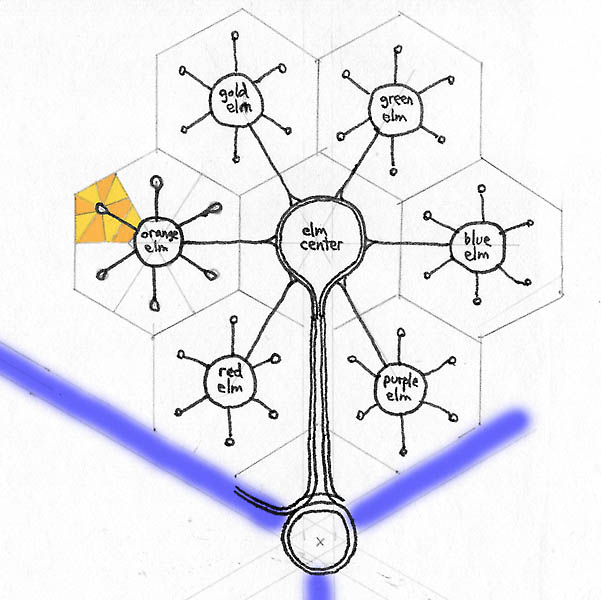
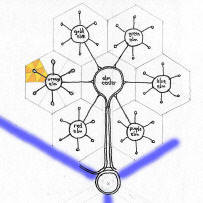
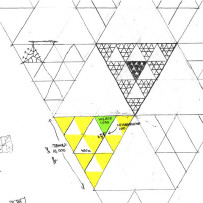
A thousand suburban homes could be reached from the traffic circle at the bottom of this diagram, in the center of a hierarchy of culs-de-sac. Having reached the circle via any of the three blue highways, you leave it in any of three other directions. Only the northbound four-lane boulevard is shown. You soon arrive at the Elm Center shopping area, where you have six choices: six avenues leaving Elm Center, called Purple, Blue, Green, Gold, Orange, and Red.
(TEXT
CONTINUED BELOW) If you go west on Orange, you find yourself at a smaller neighborhood circle called Orange Elm. Here you have another half-dozen choices: six numbered streets, each with ten home sites grouped around a cul-de-sac. The home sites shown in color are on this neighborhood circle's Fourth Street, and their addresses would be 40 through 49 Orange Elm. Culs-de-sac can serve more homes with less pavement than the more traditional system of gridlike streets. But to achieve this efficiency, they sacrifice redundancy. In the traditional system, as you leave your driveway you can turn either left or right and still find your way to your destination. But in the system shown above, if the avenue between Orange Elm and Elm Center were blocked by an accident or a fallen tree, Orange Elm would be completely cut off from the outside world. Those 60 families would be trapped. They would be unable to drive to work, and fire trucks and ambulances would be unable to reach them. Therefore, it would be necessary to construct alleys behind the home sites (along the hexagonal pencil lines in this drawing) to serve as an emergency access. |