|
|
|
|
|
|
|
|
|
|
|
|
|
|





GALLERY
OF DESIGNS — click
a thumbnail for a larger version
Dwellings













|
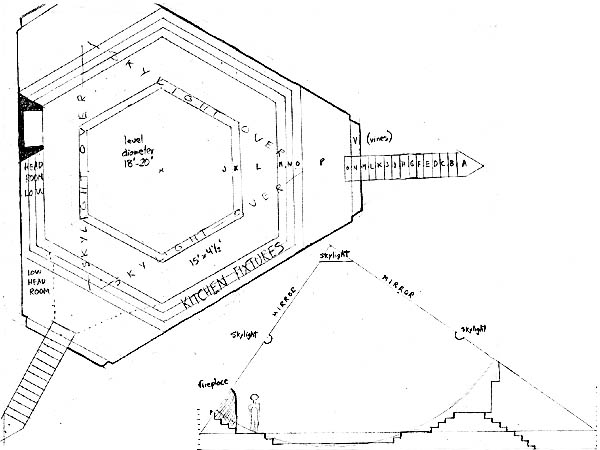
Access to this great room is via stairs that rise up through the points of the triangle, where the headroom would otherwise be lowest. From a trapezoidal landing, the floor then actually steps down again to a ring 4½ feet wide, and then down once more to a hexagonal central space 20 feet across.
(TEXT
CONTINUED BELOW) Seen in cross-section (the lower right portion of the drawing), the profile of this sunken floor approximates part of a circle centered on the apex of the three mirrors. The idea is to make the reflected floor appear to be the inner surface of a sphere 60 feet in diameter. At the apex is a flat triangular skylight; the mirrors turn it into a bright octahedron floating in the center of the sphere. Each of the three mirrors is bisected horizontally by a narrow skylight about 35 feet long. These lights and their reflections provide natural illumination inside an otherwise closed pyramid.
|
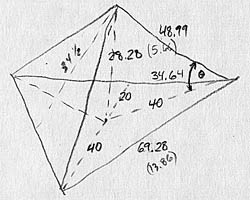 Here's
another exercise in using orthogonal mirrors to increase the
apparent volume of a room at the top of the house. In this
case, three triangular mirrors form a pyramid over a triangular
floor. The multiple reflections increase the space eightfold.
Here's
another exercise in using orthogonal mirrors to increase the
apparent volume of a room at the top of the house. In this
case, three triangular mirrors form a pyramid over a triangular
floor. The multiple reflections increase the space eightfold.