|
|
|
|
|
|
|
|
|
|
|
|
|
|





GALLERY
OF DESIGNS — click
a thumbnail for a larger version
Dwellings













|
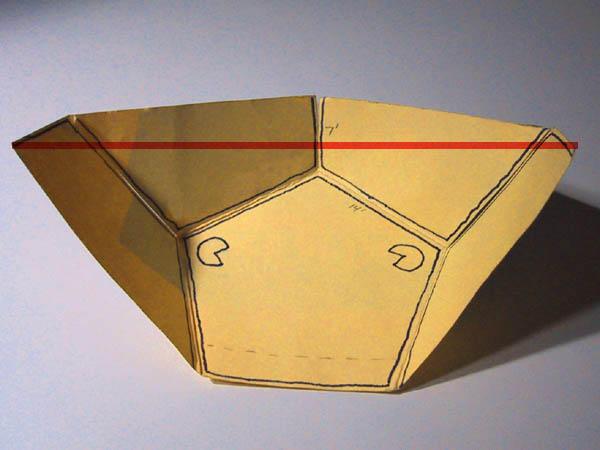
We could build a recreation room in this shape, say with each edge 14 feet long. One of the pentagons would be the floor and another ceiling. But the ceiling would be more than 30 feet above the floor, wasting a lot of space. So I made a paper model (below) to show how mirrors could be used to achieve the same effect in one-quarter the volume. The floor is again a pentagon 14 feet on a side. On four of its five sides, the room has outward-sloping walls consisting of half-pentagons. Because these walls are not vertical, ordinary swinging doors might not be practical; the doors would be more like hatches. Perhaps their thresholds could be three feet outside the pentagon. Or access to the room could be through its floor via spiral staircases from the level below; I've drawn three-quarter circles to indicate the tops of these staircases.
(TEXT
CONTINUED BELOW) The four wall edges that you see across the top of this picture would meet a large ceiling mirror (not shown). The mirror would slope up at an angle of about 28° from the horizontal. At its high point, the red line, this mirror would intersect at right angles a large wall mirror inclined about 28° from the vertical. That mirror would meet the walls at the left and right of this picture and the floor at the bottom. Because of the slope of the wall mirror, headroom would be limited on the near side of the floor; the faint dashed line marks the end of the usable floor area. The edges of the pentagons and half-pentagons (black lines on the model) would be illuminated. Reflected in the mirrors above, these bars of light would form the image of a complete dodecahedron. Party on!
|
 A
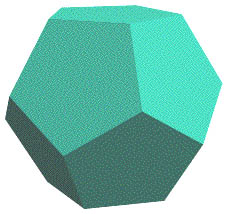
dodecahedron, one of the "Platonic solids" of classic
geometry, is bounded by twelve regular pentagons. What would it
be like to live inside a dodecahedron?
A
dodecahedron, one of the "Platonic solids" of classic
geometry, is bounded by twelve regular pentagons. What would it
be like to live inside a dodecahedron?