












Homeward
Bound, Part Two
Written February
14, 2016
In Part One of this article, I told about the service of two people during World War II. Both were stationed in India, in the northeastern province of Assam, though I don’t think they ever met.
One was an Army nurse from Wisconsin, Signe Skott.
The other was my father, Vernon Thomas. Photos he took are identified by red borders in this article. The remaining pictures come from other sources. Those identified by blue borders are intended to illustrate his troop ship's surroundings but actually are distant views of another vessel.
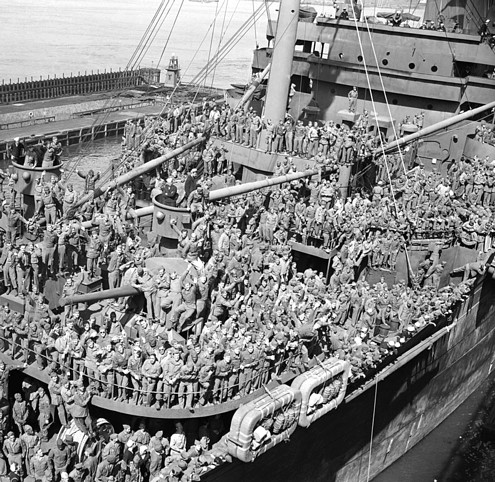
The European portion of the war ended when Germany surrendered on May 7, 1945. Barely two weeks after V.E. Day, thousands of American war veterans, their services no longer needed to fight the Nazis, left Naples on the General W.P. Richardson. When she docked in New York on June 7, The Atlantic took this picture. The 11,450-ton troop ship was 623 feet long (415 cubits) and had been launched only ten months before.
Then Japan surrendered on September 2. Full demobilization would require many months, because the Army had eight million troops, but they managed to release half of them by the end of 1945.
Signe explained, “You got so many points for length of service. You got so many points for overseas service. And if you had so many points, then you were sent home. So I was in the group that was sent home.”
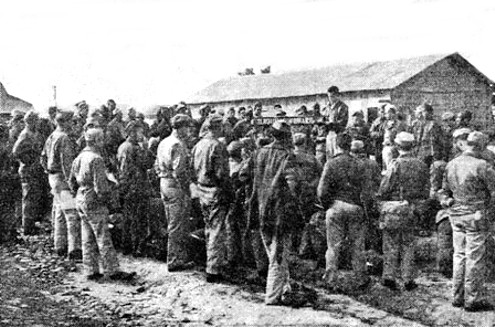
Vernon was also in that group. A Signal Corps photographer took this picture of a different Tuttle, T/4 Wayne K. Tuttle, briefing homebound GI’s at the Movement Control Depot at Chabua before they boarded a C-54.
|
|
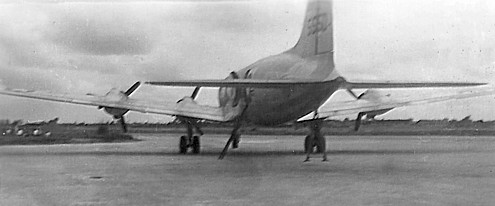
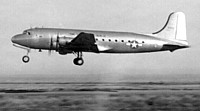
That’s my father’s plane above, and a similar aircraft on the left. |
|
|
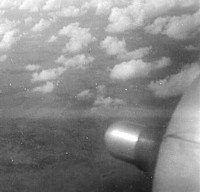
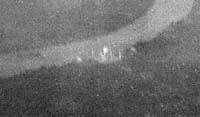
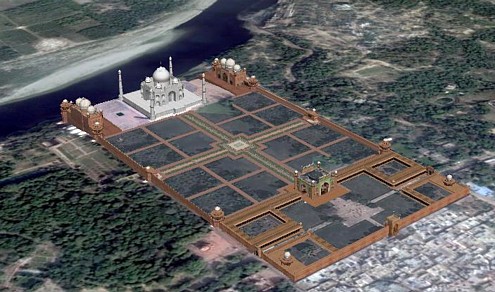
On Monday, October 15, he and about 40 other men traveled some 1,800 miles west to the port city of Karachi. “We flew over the Taj Mahal on our way,” Vernon recalled. “It was beautiful — especially the dome.” He snapped a fuzzy picture of the monument along the Yamuna River. For a clearer view of what he saw from his airplane window, below is a similar angle from Google Earth. |
The plane landed at Karachi Air Base (KAB). However, the Richardson, which was to carry them the rest of the way home, had sailed from Boston only the day before. She would not arrive for another three weeks.
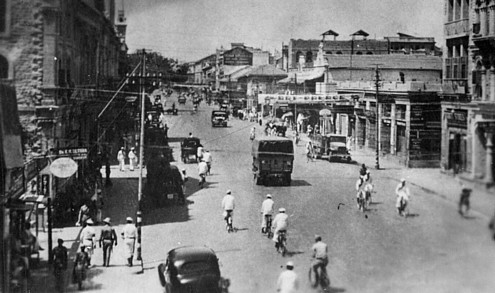
Matt Rudoff took the picture above of the main avenue in Karachi on November 30. Less than two years later, this would be part of the new nation of Pakistan, with Karachi as its largest city.
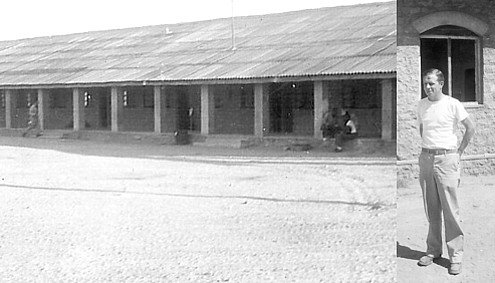
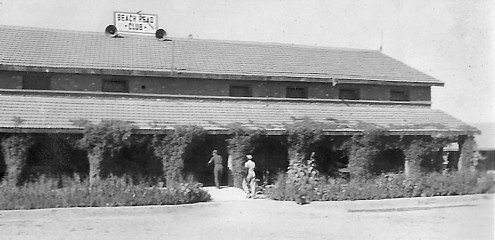
The servicemen waited at the processing area called the North Malir Barracks (above). Vernon killed time at the Beach Head, a Red Cross club (below).
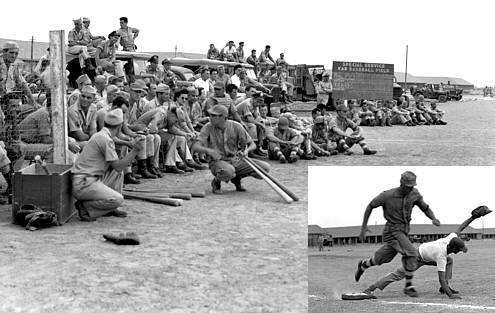
Other GI’s found their way to the Special Service KAB Baseball Field.
Finally, on Friday, November 2, their ship came in.
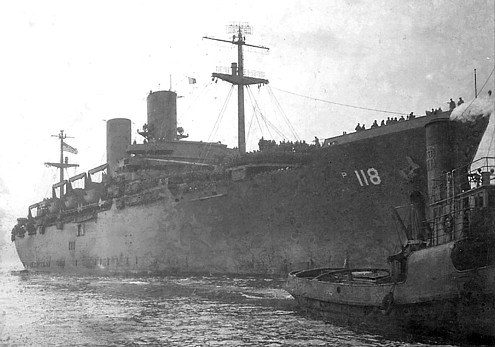
By Sunday, she was ready to welcome more than 5,000 passengers.
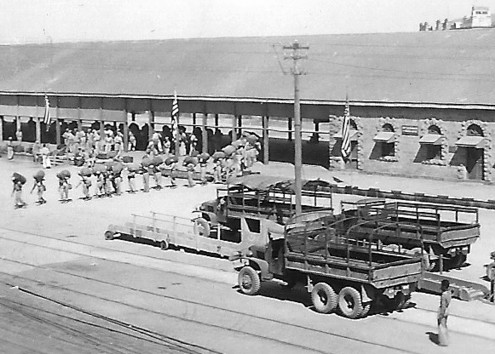
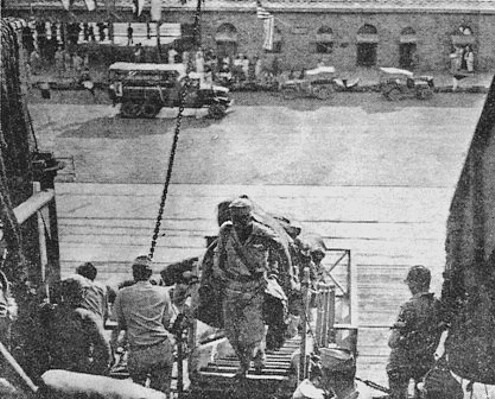
Boarding
at Karachi, from the February 14, 1946, edition of CIB
Theater Roundup.
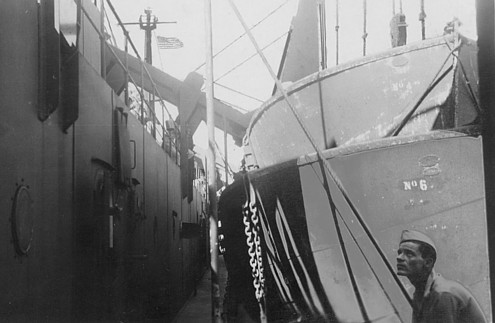
As one soldier came on board, he looked up to see Old Glory flying atop the superstructure. I'm reminded of a phrase from the fourth verse of “The Star-Spangled Banner.” This would be the Richardson's 11th round trip transporting free men who stand “between their loved homes and the war's desolation.”
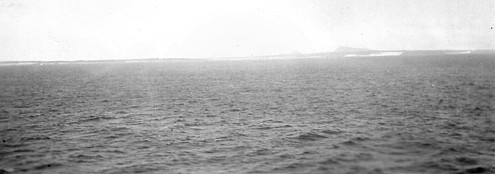
Once Vernon and Signe and the rest were aboard, the Richardson departed the next day, November 5. Vernon labeled the picture below “my last look at India.”
Less than two years before, on his outward-bound journey to India, German submarines had been on the prowl, and the troop ship avoided the North Atlantic in favor of a longer route around the southern tip of Africa. But now the U-boats were gone. Ships could once again safely make use of a shortcut, the Suez Canal (the yellow diamond on this map).
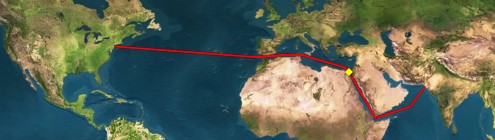
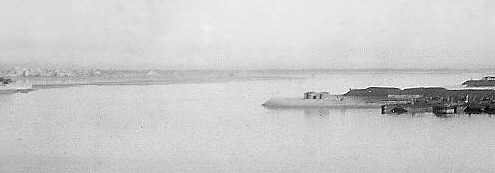
The Richardson sailed 2,000 miles southwest through the Arabian Sea and the Gulf of Aden. Passing the tip of the island of Perim in the strait of Mandeb (shown in the photo below, I believe), the ship turned northwest and entered the Red Sea.
After another 1,400 miles, the Suez Canal welcomed the Richardson on Sunday, November 11.
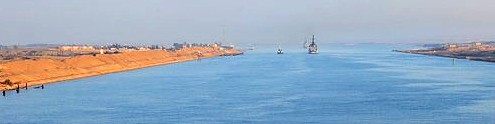
This sea-level shortcut, 120 miles long and over 600 feet wide, was first envisioned in the days of the Pharoahs and actually built by the French in the 1860s.
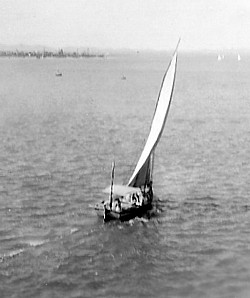
Here
large ocean-going vessels shared the waterway with local Egyptian
sailboats called fellucas.
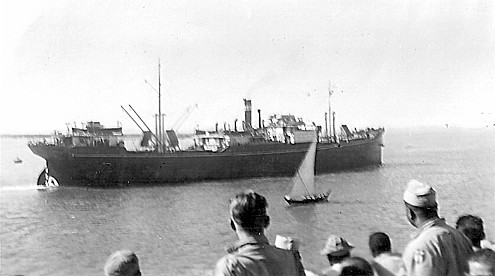
|
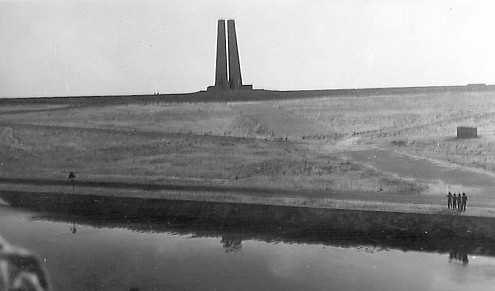
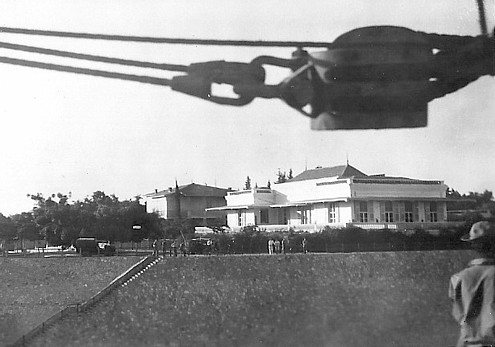
Vernon took a number of photos that he labeled “Along the Suez Canal 11-Nov-45.” Now known as Veterans Day, the eleventh day of the eleventh month was then called Armistice Day, because an armistice had ended the fighting in the previous World War at 11:00 am on November 11, 1918. To commemorate repulsing a Turkish threat during that war, France erected a pair of 160-foot columns at Ismalia (below). It's the Suez Canal Defense Monument. |
|
Signe recalled that “the ship stopped right smack in the middle of the Suez Canal. And I said to somebody, ‘What is going on?’
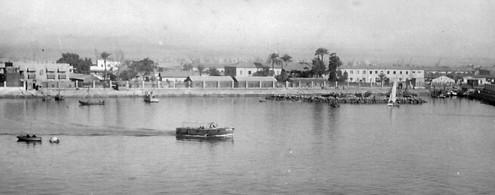
“And they said, ‘Well, we have to pay for going through the Suez Canal.’ Apparently the British charged them a toll.
“And I said, ‘Pay?’ And they said, ‘Yeah, they have to pay this in gold.’”
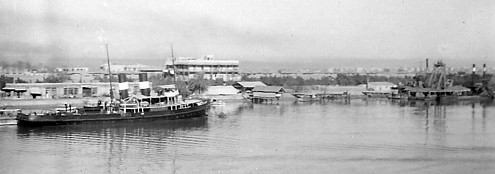
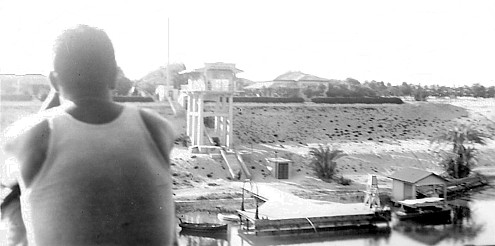
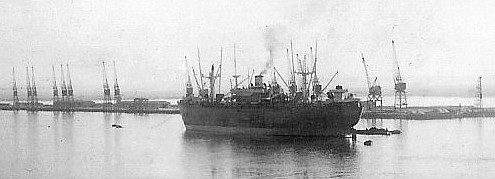
The Richardson reached Port Said at the northern end of the Canal on Monday. Passing the freighters docked there, she sailed westward through the Mediterranean Sea.
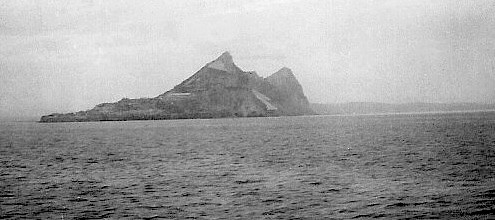
Vernon’s final pictures on this voyage, taken that Friday, showed the Rock of Gibraltar. He may not have been sure how to spell it, because he labeled them “The Rock ‘Gia’ 16 Nov 45.”
From there, it was westward across the Atlantic to New York, a crossing that took all of the next week. “Pretty much that was an uneventful trip,” said Signe, “except that when we were almost home, we hit a storm — a bad storm. And I can remember going down to eat, and on the tables they had these little shelves up. And the dishes were flying around! Oh, my. People were making jokes about collecting submarine and flight pay, and all that. It was really a bad storm.” That would have been around Thanksgiving Day, November 22.
The ship reached New York late in the evening on Saturday, November 24. Signe said, “When we saw the Statue of Liberty, of course, we were seeing her from the front. And one of the GI’s said, ‘I am going to get a good look at her front, because I only want to see her from the back from now on!’”
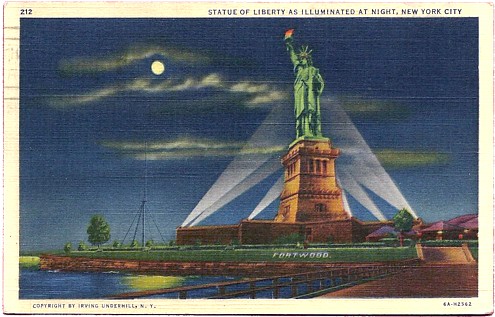
Vernon expressed surprise that not everyone joined him topside to cheer the sight of Lady Liberty. “I thought more people would be crowding the rail.” Perhaps many of the servicemen were below, gathering up their gear and saying goodbye to their bunkmates. As soon as the ship docked, they were eager to march down that gangplank, get discharged, and return as soon as possible to their American lives.
The nurses and soldiers were taken to military installations in New Jersey. “We were sent to Fort Dix,” Signe said. “Oh, the other funny thing was breakfast at Fort Dix. We got in late at night, so the next morning we all go off to breakfast. I wish you could have seen what people were eating. Hot fudge sundaes. Malted milk. BLTs. All this stuff they hadn’t had, they were available.”
Vernon went to Camp Kilmer and from there to Fort Indiantown Gap in Pennsylvania, where he was discharged on November 28. The war was over!
You're invited to visit related articles on this website. In addition to the central story, A Methodist Accountant in India, they include:
On
the Homefront
As Vernon
prepares to head overseas, his wife writes to her mother.
B.R.
Isaiah
On India's
religions, the changes brought by Christianity, and a church that our
family built.
Dearest
Ann
Excerpts from
Vernon's letters from Calcutta in 1944, including examples of V-Mail.
Flying
the Hump
An air crew's
map of the route from Chabua to Kunming.
India
1945
Color photos.
Also see an article about Memorial Bricks.
|
|
|


