|
|
|
|
|
|
|
|
|
|
|
|
|
|
|
|
|




GALLERY
OF PHOTOS — click
a thumbnail for a larger version
Cambridge 1950 My
Childhood Home on Highland Avenue













|
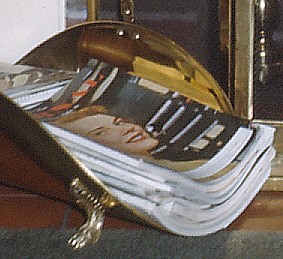
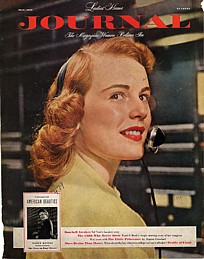
These 35mm slides have no markings. I wasn't sure of the exact dates when they were taken. But there was a clue: the top magazine in the basket beside the fireplace. The letters RNAL are visible. I guessed that this was one of the periodicals that my mother read, the Ladies Home Journal.
I found a website that depicts many Journal covers from 1890 to 1972. Within minutes I had pinpointed the date of this particular issue: May 1950. Coincidentally, the model on the cover portrays a telephone operator. My mother had been an operator until the end of World War II in 1945.
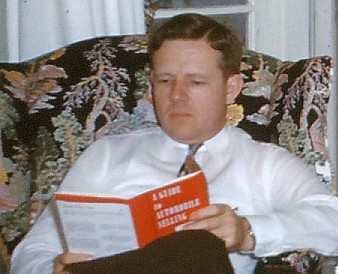
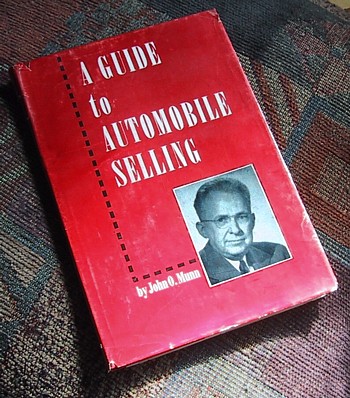
Again the Internet quickly provided the answer, allowing me to actually look inside that little red book that my father was holding.
Munn offers philosophy. "This training course deals with the salesman not as manpower, but as a human being; the dealer not principally as an outlet for some factory, but as a purveyor of satisfactory miles of transportation; the buyers not as markets, but as individual people; the automobile not as a marvelous mechanical masterpiece, but from the standpoint of the benefits it confers upon humanity." He offers practical advice. "Don't make an estimate of the used car value in advance, or say it's worth from $400 to $500. This will kill the prospect's confidence in the accuracy of your ultimate price, and besides he will never hear anything but the $500." He introduces an alternative term for potential customers, suspects. That's a word that I later heard my father use jokingly for people who looked at cars but were never going to buy. "Know something about the prospect, his family, and the use he is to make of the car. This often enables the salesman to qualify the customer as to whether or not he is financially able to buy the car. Thus he is in position to devote more time to actual prospects than to mere 'suspects.'" Munn had been in the auto business since 1909, when few people actually owned horseless carriages. Perhaps, then, it's not surprising that he included a chapter that sounds odd to us today, when everyone has a car and considers it a necessity. The chapter sells the idea of owning "Humanity's Most Prized Possession." Some excerpts: The automobile was the greatest improvement in individual transportation since creation. Man was superior to every being in all respects with the single exception of speed. For thousands of years his ingenuity had failed to overcome this handicap. Man built Babylon and Rome. He created amazing scientific and architectural works. But the monkey could still run rings around him. Then the automobile was invented. It gave him final and absolute supremacy over every other being. Getting around, going places, seeing people, doing things — that's life. How to get at it is the problem. Time and distance are the great barriers. But not to the one who drives an automobile. With any car — even the cheapest car — you can visit the old home as soon as you desire and as often as you wish to go. Kinsfolk, friends are not miles but only hours or even minutes away. Troubles fade into the horizon behind your car as it speeds to scenes of contentment, recreation and gaiety. Surely with the ownership of a car comes happiness. A life is in the balance. The doctor is miles away. How is he going to come quickly? In his automobile. Step into your own car. It takes you out to sunshine, to fresh air, to new scenes, to pleasant associations. East, West, North, South — wherever Hygeia beckons you can go because you own a car. People who buy cars keep fit. Ownership of a car is one of the greatest aids to personal achievement that any man can provide for himself. So, an automobile salesman can well be proud of his occupation. He should think, talk and feel the benefits that the use of an automobile confers on humanity. It is contagious. He is really and truly selling the world's most wanted merchandise and humanity's greatest time and place utility. |