












TEN THOUSAND STRONG
In his first 27 months in office, President Donald J. Trump told more than 10,000 lies! That was the word this week from Washington Post fact-checker Glenn Kessler. Since last September, our leader has been averaging one false or misleading claim every hour, day in and day out.

Today, however, I want to tell you about a different 10,000 — the number of alumni from my college, as memorialized in our century-old alma mater “Ten Thousand Strong.” (Why “ten thousand”? We've had more than 10,000 alumni for a long time, and now there are over 40,000. I went looking for the source.)
When we sing the alma mater, we promise “Our hearts shall be thy throne.” That is, if we remember the words. Or the tune. I've written a new article, The Story of 10,000, to jog the memories of my classmates.
The story also alludes to the institution's historic efforts to abolish both slavery and segregation while encouraging all students to “smile a recognition of a common humanity.”
OLD OBERLIN, BRAVE MOTHER
“Our hearts shall be thy throne,” we alumni promise when we sing Oberlin College's Alma Mater. That is, if we remember the words. Or the tune.
I've written a new article, The Story of 10,000, to jog the memories of my classmates.
The story also alludes to the institution's historic efforts to abolish both slavery and segregation. Oberlin encourages all students to “smile a recognition of a common humanity.”
 omit
omit
The Story
of 10,000
Written March 10, 2018
Listen up, Oberlin College alumni! Our official Alma Mater, written in 1913 and sung at every reunion since, is “Ten Thousand Strong.” But not many of us are familiar with it.
If you search the Internet for that title, you're probably led instead to a song about Armageddon by the heavy-metal band Iced Earth. That's not the same at all. We're talking about this old piece of music.

On the
Internet I did find this video
of a group performance, apparently led by Brünnhilde in the Root
Room of the former Carnegie Library. Hojotoho, brave Mother!
|
|
Ten
thousand strong
In lands afar
Alma
Mater, Alma Mater,
CHORUS: |
|
|
Yon ivied walls
There age
and youth —
Alma
Mater, Alma Mater,
CHORUS |
|
|
Ye colors old,
Or should
thy form
Alma
Mater, Alma Mater,
CHORUS |

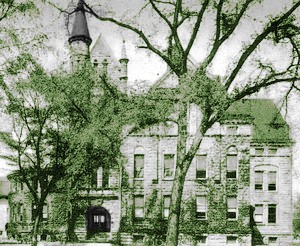
Surprisingly, the Alma Mater was written by neither a student nor an alumnus, but rather by Pittsburgh-born minister Jason Noble Pierce. From 1910 to 1914 he was the pastor of Oberlin's Second Congregational Church. That church stood on the present site of Bibbins Hall, the main building of the Conservatory of Music.


You may wonder about the mention of “setting bondmen free.” That alludes to the Underground Railroad and similar abolitionist activities in the 19th century.
|
|

The bigger question remains, why did Rev. Pierce refer to “ten thousand”? There were 38,000 alumni in 1913. Today the college boasts more than 40,000 graduates and former students.
Now it's true that 23.6% of those graduates make annual contributions. (That's the 2016-2018 average from the Council for the Advancement and Support of Education). So the number of alumni who support the college financially is in fact ten thousand — almost. Almost three thousand made contributions on a single "All In for Oberlin" day (April 25, 2019).
I've found what may be the earliest appearance of the “ten thousand” meme in an address given by James Harris Fairchild, professor of theology and moral philosophy, on the eve of the Civil War.
In 1835, Oberlin had become the first college in the United States to admit students of all races. In 1858, the town helped rescue an escaped slave, John Price. The fervent abolitionist who hid Price in his home for three days was James Fairchild. That's his home on the left below, on the site now occupied by the dormitory Fairchild House.

James Fairchild would later serve as the college's president for a quarter of a century (1866-89 and 1896-98.) But on August 22, 1860, he spoke to an assembly of alumni and reviewed the college's first quarter century.
“In the 25 years past, more than ten thousand students have been connected with the institution, and few of these have been here so short a time as not to have their prejudices removed, their feelings liberalized, and their interest quickened in reference to the colored race.
“To this result, no special means have been necessary. They meet, from day to day, those whom nature has tinged with a darker shade than themselves, but engaged in the same pursuits, cherishing the same aspirations, gifted with the same powers, and sharers in a common destiny. A supercilious air seems out of place. The lip that at first curled with contempt, will at length smile a recognition of a common humanity. What men most require for the cultivation of a fellow feeling, is to look each other fairly in the face. So have we found it here.
“And, of the ten thousand who have gone from among us, there are probably few that may not be relied on as the enemies of oppression and the friends of an abused and neglected race. The widespread influence which these must exert — in the family, the school, in the church, and in the State — cannot be compassed by human vision.”
Yes, Oberlin has always humanized and liberalized young people before sending them out to change the world.
 omit
omit
|
|
|


