












Happy New
Year 1800 BC!
Written April 21, 2019
Earlier this year in Archaeology magazine, I discovered a one-page description of an astounding five-pound object that turned up in Germany 20 years ago.
|
|
But first, some astronomy. This badge on my Subaru represents the Pleiades star cluster, the Seven Sisters (some say six) well-known to humankind before we washed out the night sky with our artificial lighting. |

|
Stars appear to move daily across the sky from east to west, just like the sun. When they reach their highest point above the horizon, that's called their culmination. |
|
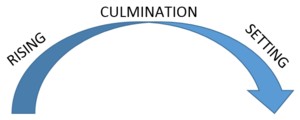
At what hour do the Pleiades culminate? That varies throughout the year. In the spring, it's during the daytime, so we can't even see the cluster. On November 21, it happens exactly halfway between sunset and sunrise — a Midnight Culmination of the Pleiades. This MCP occurs only once a year.
|
|
Due to the precession of the equinoxes, in 1800 BC the MCP happened not in November but on the date we would call September 29. Let's imagine that this marked the start of a new year, as does Rosh Hashanah (which has nothing to do with stars.) |

However, people track time not only by days and not only by years, but also by the phases of the moon.
How many days are there in a month? How many months in a year? Our modern calendars have fudged the answers to divide a year into 12 unequal slices, so thirty days hath September and so on. But if you watch the skies, a synodic month (from one new moon until the next) is actually only 29½ days long.
|
Divide 365¼ days by 29½, and you will find that the number of moon-cycles in a year is more than twelve and a third. |
|

If you reckon a year as only 12 synodic months, you're always going to come up about eleven days short. So you'll occasionally need to delay the New Year celebration by inserting an extra “leap month.” You don't need a 13th month every year, only about one year out of three. It's one out of 2.714 in the Jewish calendar, which adds an extra Adar seven times in 19 years and calls it Adar Alef (the equivalent of inserting an extra “March One” before the usual March).
|
|
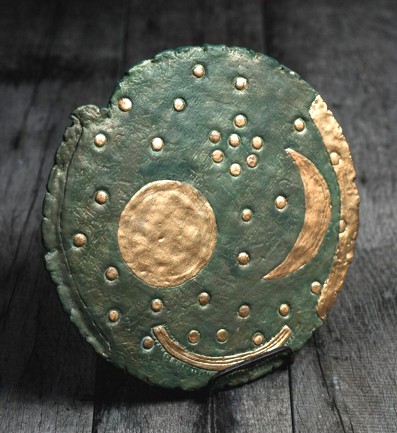
One interpretation claims that it was for the purpose of remembering when to insert the intercalary month that an ancient craftsman applied gold leaf to this bronze disk about 1800 BC. It was buried two centuries later. (Objects found with it have been dated to about 1600 BC.) Dug up in 1999 AD near Nebra, Germany, it's been named the Nebra Sky Disk. It's about a foot in diameter. |
According to John Pratt, the gold dots are stars in the midnight sky, looking south. The culminating Pleiades are represented by the group of seven dots near the top. The moon is represented twice, in two different phases: as a crescent on its way to set in the west, and as a full moon preparing to rise in the east. The time between these phases is about ten days — a third of the moon's orbital period. So on the night of the MCP, the moon will happen to be in this particular third of its orbit in one year out of three.
One problem: for astronomers in 1800 BC it would have been difficult to identify the MCP precisely.
|
•
Lacking a sextant, how could they tell that the Pleiades had
culminated, reaching their maximum elevation of, say, 63° above
the southern horizon? At midnight, the slow apparent motion is
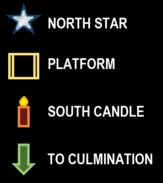
not upward but rightward Perhaps they first took a candle to a place from which Polaris appeared to be directly over a distant platform. They set the candle down and walked due north. From the platform, they looked back towards the candle, which would be due south. The culmination would take place when the Pleiades were directly above the flickering light, which could later be replaced by a standing stone. |
|
|
|
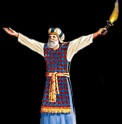
To predict the correct night, it might have been necessary to tally 365 days since the previous MCP. I can imagine a priest on the platform with a torch. Pointing to the stars, he declares, “On this very night, our daycounter hath foretold, that sign shall appear at midnight. It hath now appeared. Therefore this must be the moment, the midpoint of the night. A new year hath begun! Blow thy noisemakers!” |
|
 .
.
Nevertheless,
we can deduce what the rule for inserting a 13th month might have
been. I've imagined something like this:
The culmination of the Pleiades occurs at midnight to mark the start of each new year. This will occur during the season of the autumnal equinox, in the month we call Harvest. We can light a bonfire, stay up late to watch the stars, and maybe even ceremonially drop a ball.
On that night, if the phase of the moon happens to be between First-Quarter and Full — the situation depicted symbolically on this disk — we must declare the newborn year to be a Grand Year.
|
In 1812 AD, John Brady quoted a parody of the French revolutionary calendar in which its months were “translated” into English as Wheezy, Sneezy, Breezy, Slippy, Drippy, Nippy, Showery, Flowery, Bowery, Hoppy, Croppy, and Poppy. I suppose an intercalary month would have been trippy. |
The month of Harvest will end when the next new moon is proclaimed, and in an ordinary year there will be eleven more cycles of the moon until the next Harvest. These months shall be called Pumpkin, Snow, Yule, Ice, Groundhog, Squalls, Showers, Flowers, Weddings, Heat, and Dogdays.
However, in a Grand Year we must count twelve more cycles of the moon before the next Harvest. The extra month shall come after Squalls and be called Bluster.
By this law, the heavens shall always be kept in time!
Astronomer
Ralph Hansen found a similar rule in the “Mul-Apin”
collection of Babylonian documents from about 700 BC. I'm not
sure that the disk was really made for this purpose, but if so, it's
an amazing early scientific achievement.
According to archaeologist Harald Meller, “The functioning of this clock was probably known to a very small group of people. The sensation lies in the fact that the Bronze Age people managed to harmonize the solar and lunar years. We never thought they would have managed that.”
|
|
|


