











Union
Theatre
Written
July 22, 2022
When I was a child, my village of fewer than 2,000 people had its very own movie theater. I dimly remember only two times that I was in it.
|
The location was the Opera House in Richwood, Ohio, erected in 1890 to serve as a town hall. Writing in 1986 in Family Heritage: Union County, Ohio, Mildred Montgomery told about the building: “In front of the Opera House is a large square, paved with sandstone and used as an entrance.” |
|

It might have been called “the public square.” Notice the evergreen in the photo above. I've found an old newspaper reference to “the beautifully lighted and decorated Christmas tree on the public square.”
|
In
the overhead view on the right, the evergreen tree is gone, but I've
bracketed Mildred's “large square” in orange. “We
children used it for a skating rink,” she recalled. About
50x22 feet, it doesn't seem that “large” compared to a
hockey rink. |
|
|
|


Mildred continued, “First floor was and is for the Mayor's Office, the Jail and Fire Station; trials were often set up there also. Second floor was for movies, minstrel shows and other home talent plays, lecture courses through the winter months, school operettas, class plays and graduations.”
|
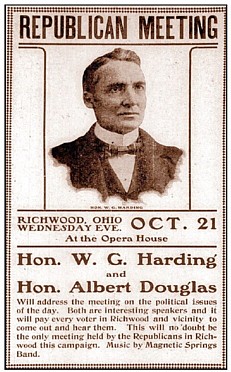
The second-floor auditorium seated about 300 people and may have included a small balcony. Here are some of the events that took place there. ® A Republican meeting on Wednesday, October 21, 1903, featured future President Warren G. Harding as well as a band from the resort town of Magnetic Springs, seven miles away. Three years later, the construction of an interurban railway from Magnetic brought in additional patrons. ® The Dubbs family put up a screen and showed silent movies, with Marjorie Dickason Sanders and Louise Laymon providing the accompaniment.
|
|

® In 1922, high school students performed Miss Cherry Blossom. “With its wreath of cherry blossoms and Japanese decorations,” the local newspaper reported, “the stage presented a pretty setting for the play.” (In the left margin you can glimpse, courtesy of Charles Lynn Barry, the decor for a 1937 minstrel show.)
® Then, in May of 1922, the senior class enacted a farcical college comedy called Professor Pepps.
® The Richwood Symphony Orchestra performed in the auditorium in the 1920s through the 1940s.
|
|
||||||

|
® Elementary students under the direction of Emelyn Close performed a children's operetta in 1924 called The Smuggleman, which had been written in 1910 by Elizabeth Rheem Stoner of Pittsburgh. The title character interacted with two boys: Toots, who was naughty, and Billy, who wasn't. Also on stage (below) were their mothers plus various grandmothers, horses, knights, fairies, and gnomes, all portrayed by the grade-school kids. |
|


® Then the “much-worn scenery” (in the words of the Richwood Gazette) was replaced with three stage settings from a Columbus company: a new woodland scene, a street scene, and an interior, all for a price of $250.
® The next year the students presented Mother Goose's Garden (below).
 Photos
courtesy of Charles Lyn Barry
Photos
courtesy of Charles Lyn Barry
The
tradition of an annual fairy-tale operetta would continue.
However, after a new high school was built in 1939, most stage
productions moved to its larger auditorium, including a
similarly-themed operetta
starring yours truly in 1953.
As a project to help alleviate the Depression, the Civil Works Administration (CWA) paid for remodeling the building starting in December of 1933. The auditorium, with a screen and a loudspeaker and a motion-picture projector, was now located on the first floor with the village offices and jail. “The entire second floor was converted into a gymnasium with a new concrete floor,” writes Kyle Meddles for the Richwood Gazette, “and a two-bay addition was added to the rear of the building to expand space for the fire department.” By 1935, the village of Richwood, population 1,600, had its own movie palace, later named the Union Theatre!
|
|
The prices advertised on the banner hanging from the marquee seem illogical. My guess is that a decimal point was assumed, but where? If after the “1,” the prices would be $1.05 and $1.50 (with a zero having fallen off), but that seems expensive for an era when typical weekend movies cost a quarter. More likely the assumed decimal was after the $ sign and the prices were 10½ cents and 15 cents. |


|
During the early 1940s, the poster to the left of the entrance promted a newsreel with LATEST WAR NEWS! |
|

|
I don't know the date of the story on the right, but it appears to be from 1938. In that year, June 28 was indeed a Tuesday. Movies were still called “photo plays” in the newspapers, and reel changes using a single projector took forever. |
|
|
Gale Perkins recalled the theatre in a Richwood Gazette article for October 14, 2020. In what follows, I'll quote Gale's words in blue. My generation remembers cowboy stars from the '40s and '50s because we saw them on a big screen at the Union Theatre in Richwood. This theatre was managed by Jerry Anderson and located in the Opera House. It was the place to be weekend evenings when Roy Rogers or Gene Autry was the main attraction. |


There was one incident a couple of days after Halloween in 1946. Vandals entered the theater overnight, slashed the screen, cut wires, and damaged sound equipment. Damage amounted to about $400. But according to the Gazette, Anderson “made repairs to show his feature picture again Tuesday night to a capacity crowd.”
Cowboy shows and Disney movies were favorites, and people would line up on South Franklin Street just to claim the best seats in the center of the auditorium. Of course, kids liked to sit in the front rows, close to the action.
I was probably seven years old when an enterprising filmmaker brought a newsreel camera to cover a local Memorial Day or Fourth of July parade about 1953. He made a black-and-white print of his footage, and we all turned out to see our town in a special showing on the big screen.
In 1956, a U.S. Senate subcommittee held a hearing on Motion-Picture Distribution Trade Practices. Anderson claimed in an affidavit that the rentals he had to pay for each movie were “exorbitant.” But Jack Sogg of Loew's Inc. testified that Anderson paid an average rental of only $17 for the Loew's pictures he showed in Richwood, including 21 movies in the 1953-54 season and eight in 1955-56. Of course, these weren't first-run engagements. Sogg said that Loew's endeavored to serve theaters “as early as they may be reasonably entitled, on the basis of the rentals paid by them.”
|
|
Jailhouse Rock would arrive in Richwood less than three months after its 1957 release. For small-town theaters, major pictures like Seven Brides for Seven Brothers and Blackboard Jungle commanded a top rental of $20, which Sogg said “hardly covered the cost of handling the prints.” |

In those days, the entire family could attend movies without worrying about bad language or violence because most shows were made for the family. Anderson would open the theatre to elementary school children for daytime shows when special movies were released.
That was the case for my other visit, when our grade-school class walked 2,000 feet west to the theatre for a color feature involving horses. As I recall, it was a birthday celebration for our classmate Denny Roberts. I don't remember the title of the movie, but I think the first scene took place during a thunderstorm while a new racehorse was being foaled.
|
|
He was given an appropriate name, something like Storm Champion. The thoroughbred grew up and entered the Derby. Sure enough, he was inspired by ominous flashes of lightning to come from behind and win. |

I can still see excited third graders marching up Bomford Street in the middle of the day to watch Song of the South, the Disney live-action/animated film featuring Uncle Remus.
In modern times, by the way, that particular movie has fallen into disfavor because it's now considered racist.
|
Matt Singer wrote, “Disney essentially turned the plantation system into a ludicrous utopia where blacks and whites live in harmony — a harmony where the only thing that's clear is that the blacks are inferior and servile to the whites, but are content to work the fields anyway.” |
|

Those 1940s daytime shows for students continued into the '60s. The movies were a treat for families before television was available to the Richwood community.
Around 1948, I recall a store across the alley from Sieg's Drugstore with a TV in the window, turned on so folks could watch. There were generally several people just staring at it. In a few years, nearly every home would have at least one TV, and I'm certain the movie attendance began to suffer then. My dad bought our first television in 1950, and we did not attend the movies as often as before.
When my family wanted to see a movie, we preferred getting in the car for an occasional trip to bigger theaters showing first-run films in bigger towns like Marion, 15 miles away. I saw The Ten Commandments and Disney's Peter Pan at Marion's Palace Theatre in the 1950s.
Sadly, Richwood's Union Theatre closed in 1961.
|
The upstairs gym was the scene of a party for my classmate Criss Somerlot's January 7th birthday. Later, because my junior high school building lacked a gymnasium, the eighth-grade basketball team practiced here. We entered via an exterior metal stairway, presumably the former theater's fire escape. As the student manager, I had to shovel the snow off the steps.
|
|
|
|
This portal, next to the stairway leading up from the first floor, probably once had been the entrance to the auditorium seating. I think another stairway on the right led further up to a cramped locker room at the balcony or attic level. |


In the 21st century, the false ceiling and much of the rest of the building fell into disrepair.

|
I'm speculating that the red lines I've drawn on this photo represent where the bottom of the balcony used to be. The quartet of chairs by the windows may be all that's left of the original auditorium.
In 2020, the village council voted to support the Redevelopment Committee's plans to repair the historic Opera House. |
|

Triad Architects presented a conceptual design. The proposal for the first floor, according to the Richwood Gazette of October 13, 2022, would include a meeting room for the Village Council, an open office area, separate offices for the clerk and mayor, and many other features. “As the restoration will not be completed for a decade or so, the committee stressed the importance of flexibility in the structure, such as moveable walls, for different needs in the future.” One possible snag: the current mayor and village administrator / police chief “prefer to keep the municipal building with the police department at 153 North Franklin Street,” the former automobile dealership my father built in 1964-65.
On the 4,600-square-foot second floor, a space that could be rented for weddings or other events of 300 people or more, the conceptual design includes a 30- by 12-foot stage and a catering kitchen. There would be an elevator and new HVAC and electrical systems plus a new roof covering.
“The cost of the restoration project is estimated to be $1.9 million,” not including furnishings. Local donors have recently raised about $8,000. It's hoped that most of the money will come from various grant applications, and “the work will proceed in phases as the funding is available.”
It's a long-term plan. In 2023, Michael Hurwitz of the Columbus-area theatrical consulting company Telesolve told the Richwood Revitalization Committee that the Opera House project has “lots of potential. I think, under the present circumstances, I really do think it's going to be less time than 15 years. And I can tell you, it can be done.”
2025 UPDATE: On July 14, the village council voted unanimously to accept an offer from Andrew Levering to purchase the Opera House for $75,000. Levering is a small business owner who graduated from the local high school. Once the paperwork is completed, he envisions turning the lower floor into a community center with food vendors and the upper floor into “a wedding venue to bring tourism to the village.”
2026 UPDATE: On February 9, having failed to complete that paperwork, the council reluctantly voted that the old building had to be demolished.
But let's think back to the days when there was a theater here. Here again is Gale Perkins.
|
|
Even after TV at home, going to the movies in the Opera House at the Union Theatre on weekends was special. I remember the smell of fresh popcorn in the lobby and the candy case with many tempting choices. We waited with anticipation for the main attraction after watching cartoons, previews of upcoming shows, and selected short subjects. |

 Photos
above courtesy of Charles Lyn Barry
Photos
above courtesy of Charles Lyn Barry
When the movies were over about 9 p.m., we would walk north on Franklin Street to Chiesa's Ice Cream Parlor for the best ice cream in the USA.
Lynn Ledley has provided the 1942 photo below, in which Miranda Chiesa is standing in front of her family's store. According to an old newspaper ad that I found, Fred Chiesa sold homemade candy and ice cream at 116 North Franklin Street, just a thousand feet from the Opera House. That location is now the home of Wang's Kitchen.


Melva Shuman recalled in the Gazette, “Saturday nights, everyone came to town to shop and watch the people. People would park their cars during the day on Saturdays so they would have a prime seat to watch the crowd at night.”
Derek Thompson has written, “In the 1940s, the average American bought more than 30 movie tickets a year, regularly packing into theaters with scores of strangers. In the past few years, that figure fell below 4. In 2020, movie tickets sold per person fell below 1. Cinematic entertainment, born as the ultimate communal ritual, has become the ultimate personal activity — different stories mostly consumed in a state of solitude.”
I
miss those days when we would drive to town on Saturday night, view
a great movie, eat delicious popcorn and ice cream, and watch people
walk up and down the street.

|
|
|


