












|
|
|
 SEPTEMBER 2017


C3 > REUNION PLANNING SUMMIT
Last weekend I joined eighty other Oberlin College alumni on campus. We were there to prepare for an event to be held May 24-27, 2019: the reunions of graduating classes from 10, 30, 45, 50, and 60 years before. The Class of 1970 was also represented to get an early start on their 50-year reunion, even though it won't be until 2020.
|
|
|
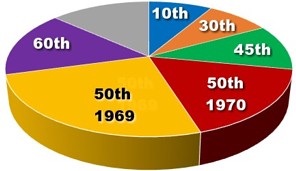
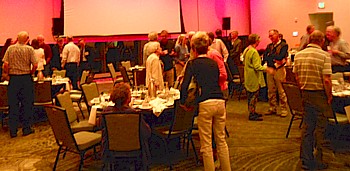
The 50th is the big one, of course. Nearly half the attendees were from 1969 and 1970. We all got together for socializing and dinners, such as the one above in the Tappan Room of the Hotel at Oberlin. But the individual classes, including my Class of 1969, also held breakout sessions to plan their particular activities.
Below are some photos. The ones with the crimson borders should be credited to John Kramer; those with the gold borders, to George Spencer-Green.
Left to right in the first group are Mr. Kramer, Biz Glenn Harralson, Mr. Spencer-Green, and the Class of 1969 officers: vice-president Carol McLaughlin Fishwick and president Wayne Alpern.

|
|
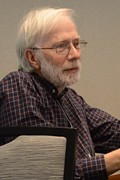
Our reunion committee got down to business, led by Walt Galloway (here flanked by Mike Jarvis and Bill Truehaft). Walt was very organized, and we accomplished a lot. |

|
|
|
|
|
|
|
|
|
|
|
|
|
|
|
|
|
|


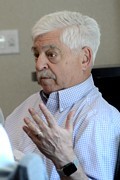 Chip
Hauss
Chip
Hauss


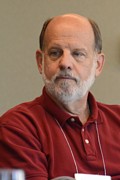 Bill
Truehaft
Bill
Truehaft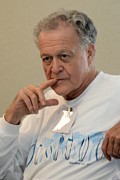 Mike
Jarvis
Mike
Jarvis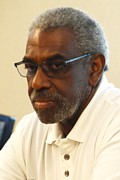 John
Bowman
John
Bowman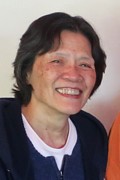 Mimi
Lam
Mimi
Lam Christie
Seltzer Fountain
Christie
Seltzer Fountain
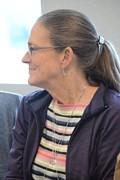 Debby
Horn Roosevelt
Debby
Horn Roosevelt
|
|
Various classmates volunteered to coordinate such events as a panel on liberal activism (Bob Weiner points out that the term nowadays is “resistance”), a service project, and another panel on the ways Oberlin has changed us. But the weekend won't be all seriousness; it will also be a time for fun and reconnections. Our plans include a talent show, a story-telling session, and the traditional men's and women's breakfasts. We might even get together as early as Wednesday, May 22, 2019, to enjoy the attractions of the big city of Cleveland! After that, we'll join the Commencement/Reunion Weekend at Oberlin, May 24 through 27. Stay tuned for further details. |

|
C3 > REUNION PLANNING SUMMIT Last weekend I joined eighty other Oberlin College alumni on campus. We were there to prepare for an event to be held May 24-27, 2019: the reunions of graduating classes from 10, 30, 45, 50, and 60 years before. The Class of 1970 was also represented to get an early start on their 50-year reunion, even though it won't be until 2020.
The 50th is the big one, of course. Nearly half the attendees were from 1969 and 1970. We all got together for socializing and dinners, such as the one shown here in the Tappan Room of the Hotel at Oberlin. But the individual classes, including my Class of 1969, also held breakout sessions to plan their particular activities.
Below are some photos. The ones with the crimson borders should be credited to John Kramer; those with the gold borders, to George Spencer-Green. Left to right in the first group are Mr. Kramer, Biz Glenn Harralson, Mr. Spencer-Green, and the Class of 1969 officers: vice-president Carol McLaughlin Fishwick and president Wayne Alpern.
Our reunion committee got down to business, led by Walt Galloway (here flanked by Mike Jarvis and Bill Truehaft).
Walt
was very organized, and we accomplished a lot.
Various classmates volunteered to coordinate such events as a panel on liberal activism (Bob Weiner points out that the term nowadays is “resistance”), a service project, and another panel on the ways Oberlin has changed us.
But the weekend won't be all seriousness; it will also be a time for fun and reconnections. Our plans include a talent show, a story-telling session, and the traditional men's and women's breakfasts. We might even get together as early as Wednesday, May 22, 2019, to enjoy the attractions of the big city of Cleveland! After that, we'll join the Commencement/Reunion Weekend at Oberlin, May 24 through 27. Stay tuned for further details.
The College's Associate Director of Gift Planning Alan Goldman, said afterwards, “The energy in the room was positive, and you all came ready to plunge into the various tasks we had for you. Because of that, things that needed to be done were indeed accomplished.”
|


JAN.
3, 2019  INTRODUCING
DELAZON'S FORTNIGHTLY CLUB
INTRODUCING
DELAZON'S FORTNIGHTLY CLUB
Oberlin College, my future alma mater, had been in operation for only 19 months when a new student arrived in the summer of 1835, Delazon Smith.
Delazon didn't make it to graduation. A racist scandalized by Oberlin's integration of blacks and whites (or “amalgamation”), outraged by enthusiastic welcomes for escaping fugitives, and disgusted by the faculty's religious hypocrisy, he was expelled less than two years later. He didn't like the food, either.
|
Smith promptly published a gossipy exposé called Oberlin Unmasked. His pamphlet is an interesting artifact of a long-gone era, including the story of how the Underground Railroad for escaping slaves reached Oberlin in the autumn of 1836. However, it's quite wordy, so I've condensed it and edited it into ten manageable chapters. I'll post one on this website fortnightly — i.e., every other Thursday — through May. |
|

(My mother attended the “Fortnightly Club” when I was growing up. These literary organizations had begun in the 19th century as a place for women to have an intellectual life even though they weren't allowed to attend college — except Oberlin and a few others. During the winter they met every two weeks to discuss a book.)
Our first meeting is today, as I unveil my Preface.
|
JAN.
17, 2019 |
 CREATING
A SCHOOL AND A COMMUNITY
CREATING
A SCHOOL AND A COMMUNITYThe year 1826 marked the death of an inspirational European, John Frederic Oberlin, a pastor from a the small town of Waldbach on the borders of Alsace and Lorraine.

Seven years later, a Utopian settlement came into being on what was then the American frontier. It was named Oberlin in the pastor's honor.
“The plan of Oberlin originated with Rev. John J. Shipherd in July of 1832, while he was pastor of the Presbyterian church in Elyria, Ohio. Associated with him in the development of this plan was Mr. Philo P. Stewart, formerly a missionary among the Cherokees in Mississippi and at that time residing in Mr. Shipherd's family.
“The plan involved a school open to both sexes, with various departments — Preparatory, Teachers', Collegiate and Theological — furnishing a substantial education at the lowest possible rates. This school was to be surrounded by a Christian community, united in the faith of the gospel and in self-denying efforts to build up the school. Families were to be gathered from different parts of the land to organize a community devoted to this object.
“A place was found, a tract in an unbroken forest entirely unappropriated by the early settlers in consequence of its disadvantages: an uninviting surface lying on the belt of clay which traverses Northern Ohio, destitute of springs and rocks and hills. The advantages were the room it afforded, its location on the Western Reserve, and the low price of the land which was still held by Connecticut proprietors. Nearly 6,000 acres was purchased at $1.50 an acre. The first ‘colonist,’ Peter P. Pease, already a resident of the county, pitched his tent on what is now the southeast corner of the college square, April 19th, 1833.”
Those are the words of John H. Fairchild, a future Oberlin College president, in 1860. Some financial support would later come from ardent abolitionists such as Arthur Tappan, a wealthy New York City merchant.
However, Fairchild admitted, “The site has been matter of frequent criticism, and many are still unreconciled.” One such critic was a student named Delazon Smith, who also had other, much greater objections.
|
Some of his disagreements were with revered religious leader Charles Finney (right), a famous evangelist of the day who would precede Fairchild as president. In Smith's 1837 pamphlet Oberlin Unmasked, he recalled a conversation with Finney. They happened to mention another preacher, and Finney demonstrated his Christian charity by denouncing his reverend brother as a liar, worse than the Devil himself. This fortnight's installment of Smith's pamphlet consists of his brief Introduction to what was then Oberlin's brief history. |
|

W
|
JAN.
31, 2019 |
|
When it was founded in 1833, my alma mater announced that “the Collegiate Department will afford as extensive and thorough a course of instruction as other colleges, varying from some by substituting Hebrew and Sacred classics for the most objectionable pagan authors.” The official seal depicts Tappan Hall, with its four classrooms and ninety student chambers, surrounded by majestic elm trees — and a wheat field. Students learned in the Hall, but they also labored in the field to defray the cost of their tuition. |
|

One such “Manual Labor System” had been established in 1827 by Rev. George Washington Gale, Charles Finney's former pastor, at his new Oneida Academy along the Erie Canal. The Academy prepared students for advanced theological training, but it also required them to perform manual labor. This made it affordable to more people, including Black students, who were first admitted there on an equal basis in 1833.
Oberlin followed suit by likewise admitting Blacks in 1835. In the same year Oberlin also enrolled Delazon Smith. The latter might have been a mistake.
Smith observed at close hand the school's vaunted academic and financial-assistance programs, and in 1837 he exposed their shortcomings in his pamphlet Oberlin Unmasked. The heading of this fortnightly installment of that book is Course Of Study, And Manual Labor.
|
FEB.
14, 2019 |
|
|
It was on this date 160 years ago — February 14, 1859 — that Oregon joined the Union. The new state's first two Senators were Democrats Joseph Lane (far left) and Delazon Smith. Oregon had been admitted as a free state, but Smith, despite having studied at abolitionist Oberlin College, “did not subscribe to anti-slavery sentiment.” Having drawn the shorter straw, he received the shorter term, which would expire when the 36th Congress was sworn in on March 4, 1859. Unfortunately, the new state's legislature declined to re-elect him, so he was out after only 18 days as a United States Senator. The seat would remain empty until a Republican was named in the fall of 1860. |


Decades earlier, Delazon Smith had also served less than a full term as an Oberlin student. “His disagreement with school policy and philosophy ... ultimately earned him an invitation to leave and not return,” whereupon he promptly wrote a book telling what was wrong with the college — including even the vittles.
|
The institutional food served in college cafeterias and dining halls has always drawn complaints. That's why so many students nowadays order pizza instead. In Smith's 1837 pamphlet Oberlin Unmasked, the disaffected former student described far worse fare at his boarding hall. Article 5 of the Oberlin Covenant had proclaimed, “That we may have time and health for the Lord's service, we will eat only plain and wholesome food ... and deny ourselves all strong and unnecessary drinks ... and everything expensive that is simply calculated to gratify the palate.” |
|

The college's leaders forbade such sinful substances as pork and pepper and coffee and tea. Students sometimes had to subsist on bread and water, like prisoners! They were, however, allowed salt.
Smith bemoaned the ban on all types of tea, including Bohea and Imperial and Gunpowder. He claimed that folks from other towns could tell that a young man was from Oberlin by his emaciated appearance, his “lean, lantern-jawed visage.”
He was so appalled that he exclaimed, “We are led to cry out in the language of the poet!” That nine-stanza tirade is the highlight of this fortnight's installment of Smith's book, entitled Board and Mode of Living.
|
FEB.
28, 2019 |
|
|
A “gateway" leading nowhere in particular was dedicated at Oberlin College in 1937. It celebrates the graduation a century earlier of the first Oberlin women. In the college's earliest years, male and female students lived in its one and only building, so special care had to be taken to maintain propriety. “In 1836,” Robert Samuel Fletcher wrote in his history, “a student was dismissed because he had ‘broken one of the fundamental laws of the institution, which is that no male student shall go into the chamber of the young ladies on any occasion without a special permission from the principal of that department.’” But let us take a closer look at the following year. On May 22, 1837, a romantic triangle departed the campus: a female student and her two admirers, one of whom would reluctantly climb out of the wagon after only a short distance. The other suitor would accompany her back to her parents' home — more than 400 miles away! |

Scandalously, this second man was a faculty member, the reverend Principal of the Preparatory Department, who had sent love letters to the female student. This may have been sexual harrasment, but it was the 19th century, so the faculty member's colleagues didn't fire him. Instead, they voted to banish her.
That's just some of the titillating gossip about the Connexion Of Male And Female Departments in the earliest years of the College. It's our latest installment of Delazon Smith's “scurrilous pamphlet.”
|
MARCH
14, 2019 |
We've reached the halfway point. From the shortcomings of student life in the early days of Oberlin College (learning, labor, sex, and food), we now turn to shortcomings of “pious” Oberlinians.
The event was called a Protracted Meeting. No math instruments were involved, just debating and preaching and confessing and praying. Sometimes these discusssions were protracted for weeks.
|
|
The people of Oberlin, all of them Christians, were summoned to one such Meeting in the fall of 1836. There they were urged to beg forgiveness for their sins. Various faculty members and students admitted to stealing chickens, eating too much gravy, wife-beating — and doubting the existence of God. |

The details of their hypocrisy are part of my serialized condensation of Oberlin Unmasked, Delazon Smith's 1837 pamphlet criticizing the institution in its fourth year of operation. (The college is now in its 186th year, and I can attest that conditions are much improved.) This installment finds fault with the Conduct and Character Of The Church.
|
MARCH
28, 2019 |
I told about Robert Ingersoll here. Like Oberlin College, Bob was born in 1833, but in New York State. His father was a preacher who worked with Charles Finney. As Robert grew up, he realized that his father's friends “did not know much, but they believed a great deal.” In particular, they believed in a God who was “thoroughly despicable.”
The confessed shortcomings of Oberlin's professors and theological students in that era were detailed in the previous installment of Delazon Smith's 1837 pamphlet Oberlin Unmasked. This time, we'll encounter some of those pious personages off campus, in the Ohio towns of Granville and Poland.
|
At Granville the convention of the Ohio Anti-Slavery Society opened on April 27, 1836. The Society was celebrating its first anniversary, but not without opposition. Some Ohioans feared that slaves would flee the South and take jobs away from Northern whites. Granville's churches and other meeting places were closed to the trouble-making reformers. Therefore, wrote Robert Samuel Fletcher, the abolitionists met in “a large temporary temple on a hill about a quarter mile north of the village.” It was actually a barn. There 192 delegates, including 26 from Oberlin, assembled on a Thursday morning. They heard Oberlin's President Mahan declare it “the duty of the church to debar from her privileges all who persist in the sin of holding their fellowmen in the bondage of slavery.” |
|

At 2:00 on Friday, the “abolitionists adjourned and returned to the town amid a shower of rotten eggs. Some of the delegates were assaulted with clubs; an Oberlin student, William Lewis, was knocked down. There was just about enough persecution to maintain the enthusiasm of the reformers at a high pitch.” Smith observed one heroic reformer who, under attack, emulated St. Peter by denying his faith. However, he then proudly wore his egg-stained hat on his return journey to the campus a hundred miles north.
The installment is titled Conduct And Character, Concluded.
|
APRIL
11, 2019 |
|
|
Across from the Oberlin College Conservatory of Music is a rather literal memorial honoring the emergence of the Underground Railroad, which came to Oberlin in 1836. During the first part of the 19th century, this network of secret routes and safe houses helped tens of thousands of slaves fleeing bondage in the South to find refuge in the North or in Canada. |

They were abetted in their flight by northern abolitionists. In particular, for three days after the “Oberlin-Wellington Rescue” in 1858, future Oberlin College president James Fairchild allowed escapee John Price to hide in his home, located just 400 feet south of these rails.
Even back in 1836, several hundred slaves were already escaping each year. Delazon Smith was an Oberlin student in those days. He presumably agreed with abolition, as he had attended the convention of the Ohio Anti-Slavery Society that spring. But a few months later, when the town first became involved with the Underground Railroad, he objected. The fleeing slaves were still legally the property of their Southern masters. Abetting their escape to freedom was not only illegal by the Fugitive Slave Act of 1793 but also a violation of Article 4 of the Constitution:
“No Person held to Service or Labour in one State under the Laws thereof, escaping into another, shall, in Consequence of any Law or Regulation therein, be discharged from such Service or Labour, but shall be delivered up on Claim of the Party to whom such Service or Labour may be due.”
Proclaiming their loyalty not to the Constitution but to “a higher law,” several Oberlin students traveled 200 miles south and stationed themselves on the banks of the Ohio River. There they enticed slaves to desert their masters and head north to freedom. One commentator later would call Oberlin “the town that started the Civil War.”

In my latest installment of Delazon Smith's Oberlin Unmasked, the author opposes this civil disobedience. He also reveals his racism, criticizing the “revolting doctrine of amalgamation” that allowed Blacks to mix with whites in polite society. Such an “abomination,” later known as integration, was a likely result of Abolition.
|
APRIL
25, 2019 |
Oberlin College's leaders naturally retained the right to expel any student who behaved in an immoral manner.
|
However, according to Delazon Smith's 1837 pamphlet, they even expelled exemplary students whose only “crime” was disagreeing with official religious doctrines. Smith disputed many policies himself. He also recalled episodes in which supposedly righteous Oberlinians had refused charity to a needy person until he renounced his version of Christianity and adopted the preferred theology. (No Universalists allowed in this house!) The pious also vilified a poor teamster who, unable to afford overnight lodging, drove his wagon into town on a Sunday. (Laboring on the Sabbath? Such awful wickedness!) |
|

This fortnight's installment of Oberlin Unmasked discusses Intolerance or Suppression of Opinion. Today, of course, the college has moved on from the “slavery of the mind” of the early 19th century, and it's much more open to rational discourse about differing beliefs.
|
MAY
9, 2019 |
Delazon Smith gradually fell out of favor with Oberlin College. His opinions were suppressed, and the Faculty cut him off from both dining and lodging. Also, the Society of Inquiry expelled him for swearing. Also, the local church excommunicated him for infidelity.
|
Finally he gave up. On Sunday, June 18, 1837, having written out his complaints in great detail, he made ready to leave town. At the time the town looked something like this. |
|

My guess is that we're looking east, which would make the dirt road on the right West College Street. The building I've labeled T is probably Tappan Hall; the one at O would be Oberlin Hall.
|
|
On Monday morning, Smith boarded a wagon. But then a constable arrived to arrest him and confiscate his manuscript! His antagonists, fearing embarrassment if the tell-all book were published, accused him of trying to skip out on a bad debt. |

Everyone proceeded to the county seat, where the authorities dismissed the bogus complaint. That enabled Smith to continue on to Cleveland, where he found a printer for Oberlin Unmasked. And that's how I've been able to bring a condensed version to you these past ten weeks.
This final installment is titled, appropriately enough, Concluding Remarks.
IN JULY 2019 [OR ONCE A FORTNIGHT], ADD THIS STUFF TO THE CORRESPONDING WEEKLY INSTALLMENTS, SO IT WON'T BE LOST. JUST ADD IT (PERHAPS IN A DIFFERENT TEXT COLOR AND/OR TEN-POINT TYPE) ABOVE A HORIZONTAL RULE BEFORE THE INSTALLMENT BEGINS, REDUCING THE WINDOW FROM 666 TO 500.
DATE > GATHER YE
|
|