














The
Very Wide Screen
Written
October 25, 2005
|
The Thomas family, my parents and I, were seated in a theater in central Ohio one afternoon. CBS radio newscaster Lowell Thomas — no relation — was addressing us from appeared to be an ordinary motion-picture screen. |
|
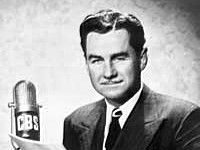
I've forgotten exactly when and where this took place. A good guess would be the spring of 1961 at the RKO Grand on East State Street in Columbus, across from the state capitol. A few months before, the Grand had been specially remodeled to become only the 11th theater in the nation equipped to show a feature called This Is Cinerama, which had premiered at the Broadway Theatre in 1952.
|
Despite the fact that this movie was now nine years old, curious Ohioans still wanted to see what it was all about. Attending This Is Cinerama was an event, complete with reserved-seat tickets. As we entered the lobby, we were handed a program, like a Playbill at a Broadway production. |
|

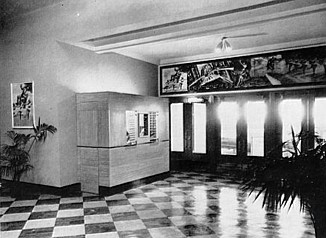
Mark Evanier explains that this motion picture was a roadshow. “A roadshow movie was one that debuted in one theater only in a given city and it ran at that theater for a long time, often more than a year. You bought tickets for them the same way you bought tickets to a Broadway show — reserved seats for a future date purchased by mail or at the box office or through a ticket agency or one or two other ways. These tickets cost more than admission to your local movie theater that was showing a double feature. Roadshow films were usually long, big budget productions with intermissions and they usually sold a souvenir book in the lobby. They also cleared the house after each showing because the next showing didn't start immediately and someone else had bought a ticket that would put them in the seat you have to vacate.”
The program explained that this movie had been photographed by a giant camera, using three lenses and three reels of film.
Some sources give different numbers for Cinerama's aspect ratio, mostly between 2.59 and 2.77.
Nowadays, IMAX theaters expand this concept into a second dimension, using spherical screens that are very tall as well as very wide. But our peripheral vision extends only to the sides, not above and below, so we never see all of an IMAX image at once.
|
|
Now we were going to see it projected from three synchronized projection booths onto a huge cylindrically curved screen, 75 feet wide and 28 feet tall. That's an "aspect ratio" of 2.65 to 1. An audience member sitting in the center of the arc — front row center in this diagram — would find his peripheral vision filled by the screen, with a field of view 146° across. |

|
Until 1952, when this film was released, both movies and TV used an aspect ratio of 1.33 to 1. (Today's HDTV has a wider ratio of 1.78 to 1.) This Is Cinerama showed that big screens could give movie theaters an advantage over their emerging competitor, television. Other innovators in Hollywood quickly developed other, more practical widescreen techniques, using single cameras with special anamorphic lenses. For example, in 1956 I saw The Ten Commandments with its 1.85 to 1 aspect ratio. While not as overpowering as Cinerama, these pictures were still far better than TV. By 1961, therefore, I was already familiar with widescreen movies. But the original Cinerama promised to be the ultimate experience. |
|

The house lights went down, and the huge 100-foot-wide curtain opened partway — about 40 feet — to reveal a movie screen. The image of Lowell Thomas appeared, in black and white and the standard 1.33 to 1 ratio.

He described the invention of motion pictures. He described the improvements that had been made over the years. And now, he said dramatically, "This . . . is Cinerama!"
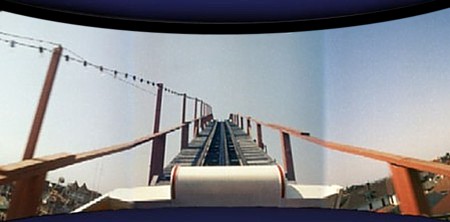
The curtain opened the rest of the way to reveal the full 75-foot width of the screen, which was immediately filled with a colorful scene. A scene of what? For a moment, we in the audience weren't sure. But then, hearing a click-click-click, we realized that we were on a roller coaster slowly climbing to the top of its track.
We had been warned about this sequence. We groaned, sucked in our breath, and held onto the armrests. The roller coaster reached the top and began its wild dash downward. We stared at the track rushing toward us. Structural supports flashed past us on the left and right edges of our vision, and we heard the screams of our fellow passengers all around us. Yes, this Cinerama was realistic!
The
process wasn't perfect. The printed program explained
that, to minimize any defects in registration, each of the three
projectors was designed to blur the left and right edges of its
image. But we were still distracted by the visible seams
between the images: two fuzzy vertical bands, one-third and
two-thirds of the way across the picture. Also, oblique lines tended
to change direction as they crossed the boundary from one lens's
perspective to another's. And the colors didn't always match.
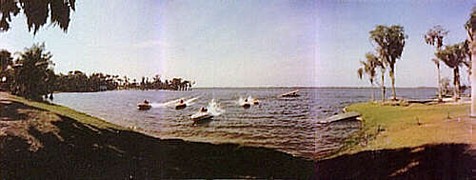
The movie had no plot. It was sort of a travelogue, designed to show off the capabilities of the technology. This was especially true of a sequence shot from a plane flying low through the Grand Canyon, banking and turning close to the canyon walls to the accompaniment of patriotic music.
Cinerama also greatly advanced the sound quality of motion pictures. Introduced at a time when all other movies were monophonic, Cinerama was not merely stereo, it was multichannel. In today's terminology, it featured 7.0 channels of audio, with five speakers spaced at intervals behind the screen plus two more channels for surround sound. These seven sound tracks came from a fourth "projector" playing magnetically-coated film.
|
After the intermission, Thomas's voice returned to say, in effect, "We're not going to show any pictures for the next couple of minutes. We'll leave the curtain closed so that you can focus your attention on the quality of Cinerama's sound. Just listen to this symphony orchestra." And it seemed as though there were actual live musicians in the orchestra pit. |
|

I was only in eighth grade at the time, so I might be wrong, but I don't think I've ever heard more realistic music reproduction.
But as it turned out, the process was impractical for feature films. One epic movie, How the West Was Won, was filmed in Cinerama in 1962. However, director John Ford and others found that the field of view was too wide for narrative picture-making. Such essential cinematic techniques as closeups and rear-screen projection just didn't work right, and it was difficult to position the actors. Also, the triple-barreled camera was awkward and heavy.

I never saw How the West Was Won in a theater. But I did see parts of it on television much later, around the turn of the century. NBC-TV aired the lengthy movie in prime time.

UPDATE: Modern digital techniques have allowed the three images to be stitched together seamlessly, with corrected perspective. Also, I suspect the extreme-left and extreme-right portions have been cropped a bit.
|
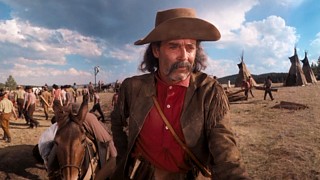
This restored version of How the West Was Won has been available since 2008. Now, in wide-screen HDTV, the film looks perfectly normal — except when an actor in closeup stands unnaturally close to the lens(es). |
|
ANOTHER UPDATE:
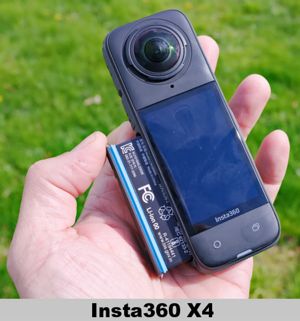
Nowadays instead of shooting with three 50°-wide film cameras and stitching the results together to form 41% of a complete circle, one can shoot 8K video with two 185°-wide lenses and use software to reformat the images into an entire circle!
|
|
These tiny "360 cameras" with one fisheye lens on the front and another on the back have at least two possible uses, according to Scott Gilbertson of wired.com. "The first is to shoot video for virtual reality (VR) headsets, where the viewer will see everything the camera captured and can choose where to look. "The second, which I would argue is more common, is to capture every direction at once and later 'reframe' in software, with the editor deciding where the focus should be and presenting the footage in a normal 16:9 movie frame." |
YET ANOTHER UPDATE:
How about a displayed width of 270°? That's 18,000 pixels from side to side, or 18K. Postcard from Earth is a 2023 film designed to be screened on the 160,000-square-foot video screen inside the Sphere at Las Vegas. We're told that additional features include scents, vibrating seats, and changes of air temperature.
|
|
|


