













Passing
Notes
Written
December 23, 2001
Wordplay and puns were high humor at Oberlin College. I tried to join in.
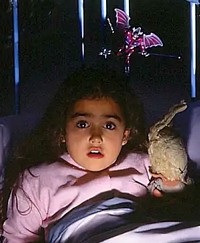
One day before class I made a comment about a "daymare." Halfway through the lecture, someone handed me a note. It was Jan Olson.
|
Jan: That was really bad . . . it took me 26 minutes to get it! Tom: Now that you've gotten it, aren't you glad I didn't call it a daystallion? Jan: YES! If you read the very interesting article in Science of the week before last, you will (if you are attentive) learn the origin of the word "nightmare," and also why a "nightmare" is not the same as a "bad dream."
|
|
|
Jan and I were both physics majors at Oberlin College, class of 1969. Neither of us became a physicist, but we did become friends. In my case, I majored in physics because I had shown some aptitude in high school. But I was more intrigued by the college radio station and made broadcasting my career. |
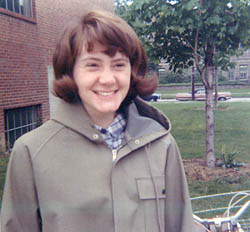
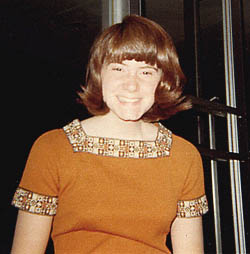
In Jan's case, she majored in physics because that was the closest that Oberlin could offer to a major in pre-med. She went on to medical school and became a doctor. We still correspond, even today.
And we corresponded then, too, even sometimes during class. I suppose that today's college students use their cell phones and pagers to send "instant messages" to each other. Back then, we used pen and ink. Therefore, our notes were slightly more erudite. And I still have, mixed in with my now-incomprehensible notebooks from physics lectures, some of those messages.
|
Tom: Many things are of value, depending on one's frame of reference. Why dost thou ask? Jan: To gain a little more insight into a favorite puzzle of mine. Perhaps that was too personal a question. |
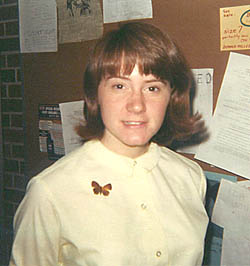
On an upper floor of the Wright Building near our classrooms and labs, there was a small quiet room with reference books, the Physics Library.
One day a student in the Library looked up and saw a silent tableau. Jan and I entered and found a dictionary. She looked up a word and triumphantly showed it to me. I peered at it and nodded reluctantly. I fished a penny out of my pocket and gave it to Jan, and we turned to leave. The student burst out laughing.
|
'Twas
12:30 p.m.,
And
I with my briefcase
Well,
no, that's not quite truthful.
So
'twas southward we trekked, |
|
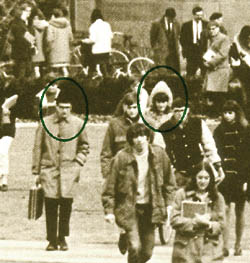
More details about our Thursday midday schedule are here.
|
Tom: May I confer with you in the hour following class? Jan: Oui. Tom: Merci. |
|
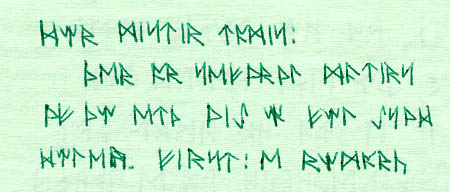
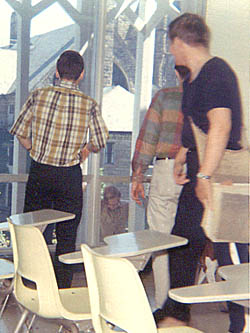
We even had a "secret language." During one vacation period, Jan sent me a letter written in Runic letters. I figured out the alphabet and replied in kind, and afterwards some of the notes we exchanged used runes. This being college, there were various odd incidents, of course. For example, one morning in May of 1968, Jan and I were both in a second-floor room in the King Building awaiting a class. To everyone's surprise, another student entered the room via the window, having climbed the ornamental grillwork on the outside of the building. Maybe the elevator was out of order. |
|
|
Tom: Don't ask why j is always 7/2. Tom: j in that level is always 7/2, while mj can be 7/2, 5/2, 3/2, etc. |
 In
some classes including Physics 36, Jan and I were lab partners.
In
some classes including Physics 36, Jan and I were lab partners.
For example, in April 1968 we aimed a laser (a recent invention) through a 0.66-millimeter pinhole, projecting this diffraction pattern onto a sheet of photographic paper 26 feet away. After a half-hour exposure, we developed the "photograph" and measured the rings (spaced about 8 mm apart) to determine the wavelength of the light. Our result, 6595 Ä, was 4.2% longer than the value on the laser's label.
|
Most of a packet of 8" x 10" photographic paper was left over after we finished this experiment, so we offered to sell it to other members of the class who were going to conduct the same experiment later in the semester. But buyers were scarce. We also misplaced the paper. |

The following month, we attempted to re-create Robert Millikan's 1910 experiment that determined the value of e, the charge of an electron.
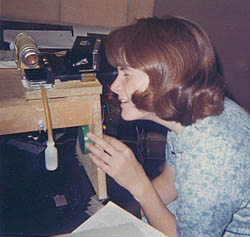 Jan
is peering at a little box which contains two horizontal metal
plates five millimeters apart. She can connect ±280 volts
to the plates with the green switch. She has used the white
bottle to squirt some one-micron latex spheres into the box, and now
she's using a telescope to watch the spheres slowly fall through the
gap between the plates. She tells me when to start and stop a
clock so that we can time how long it takes a sphere to travel 1.5
millimeters. The times vary from several seconds to half a
minute or more.
Jan
is peering at a little box which contains two horizontal metal
plates five millimeters apart. She can connect ±280 volts
to the plates with the green switch. She has used the white
bottle to squirt some one-micron latex spheres into the box, and now
she's using a telescope to watch the spheres slowly fall through the
gap between the plates. She tells me when to start and stop a
clock so that we can time how long it takes a sphere to travel 1.5
millimeters. The times vary from several seconds to half a
minute or more.
Some spheres travel at different speeds because they have a slight electric charge, corresponding to a few extra electrons. The electric field interacts with these spheres and causes them to move faster or slower, depending on how many extra electrons they've got.
Because electric charge is quantized, our results should cluster around certain values, corresponding to spheres with two extra electrons (2e) or three (3e) or four (4e) and so on. And that is what we found, at least as far as 5e.
On this graph, our results are sorted from slowest to fastest. They cluster around the vertical lines. The numerical distance between the vertical lines allows us to estimate the charge on an electron as 1.74 x 10⁻¹⁹ coulomb, which is within 9% of the accepted value.

Beyond 5e, the spheres were moving too fast for us to time them accurately. This meant that the data became too noisy to use. Notice how there are no longer clusters.
Nine years later, however, Stanford's William Fairbank used a much more refined version of this experiment to apparently detect free quarks. These are subatomic particles which have either 1/3 or 2/3 of the charge of an electron. I wrote Jan to argue that perhaps we had detected quarks ourselves. The data points shown in red might represent 5.67e, 7.33e (twice), 7.67e, 9.33e (twice), 11.67e, and 13.67e (twice), which in turn would imply some combination of quarks and electrons. I don't think that I convinced her, though.
|
Tom: He's discussing something arising from Physics Club lecture. NMR, Nuclear Magnetic Resonance. |
Finally, there was the story of the Relativitator.
Physics classes covered many subjects, from a drumhead's modes of vibration to Einstein's theory of relativity. The lectures were supplemented by several pages of handouts, stapled together for our convenience. Some students removed the staples in order to store the pages in a binder, so loose staples were lying about. I picked them up. (Why? Click here.)
How to recycle used staples? I linked them into a chain, and from the chain I hung a Flexible Membrane Relativitator. This was a thin rubber belt (cut from the neck of a balloon) stretched over a bent paper clip. The Relativitator appeared to be either a pendant or a tiny kazoo. Actually, of course, it was a highly sensitive device for examining questions on the cutting edge of science.
I entrusted this instrument to my fellow investigator. But she arrived slightly late for a subsequent class and passed me a Runic note, which I translate here.
|
Jan: You sent me some defective materials. (The chain broke.) Tom: A chain is only as strong as the weakest link supplied by our physics department. Sorry. Jan: Will you repair it free of charge? Tom: Fortunately, you still are within the 30-day warranty period. When would you like to have the necessary repair work done? Jan: After lunch? (Did he hand back the bluebooks?) Tom: I'm afraid I don't have my tools with me today. (The bluebooks are still on the table up there.) Jan: Oh, dear. I would like to get it repaired as soon as possible . . . Tom: Well, I found that there is usually one cause of chain breakage. This can be repaired without tools. Bring it around after lunch and I'll see what can be done. |
From the length of this exchange, written in another alphabet no less, you can tell that the instructor had our full attention.
|
Jan: Behave yourself. |
|
|
|
|


