














““““

OCTOBER
18, 2026  WHO
DUNNIT?
WHO
DUNNIT?
Many television dramas are police procedurals. A crime has been committed — usually murder — and the authorities need to find the perpetrator and make an arrest.
You may have noticed that these one-hour shows often climax one way or another.
|
One pattern: Someone takes the trouble to prepare a large map of the city with the scene of the crime highlighted. Along with newspaper clippings and photos of the characters, it's pinned to a corkboard. I doubt that real police use this gimmick. However, if we the viewers haven't been paying close attention, we get a reminder of who all these people are. Strings of red yarn represent connections of various pictures to each other or to locations on the map. The investigators stare at the complex board. No one seems to know what it all means. Then suddenly inspiration strikes our brilliant hero, and the cops are sent out to gather evidence and make an arrest. |
|
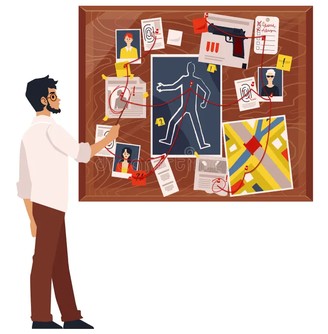
Another pattern: After 45 minutes of TV drama, the lead investigator gathers all the principal characters into a room. Beginning with Character A, he reviews how that character could have committed the crime. Then he explains how he knows that character didn't do it.
Eventually he comes to Character E, the most unlikely of the suspects. When the investigator reveals the truth, Character E confesses and breaks down sobbing. The rest of us are satisfied that justice has miraculously prevailed.
In real life, of course, Character E would deny his guilt and angrily resist being handcuffed and led off to jail. But this is not real life. It's TV.
OCTOBER
14, 2026 MINOR
CHORES
My mail-in ballot has been received at the Bureau of Elections. It was easier than usual this year; there were only five choices for me to make.
And my injections for flu and Covid have been received. I got them at the pharmacy yesterday after picking up my prescriptions. They're very efficient at CVS; it only took a couple of minutes.
Now, perhaps as a side effect, I seem to have less energy than usual. I plan to be lazy for the rest of the day.
|
OCTOBER
11, 2026 Browsing through a Walmart early this century, I noticed a bottle of Tajín Clásico seasoning from Mexico and decided to give it a try. It's made from flakes of dried chili peppers with sea salt and lime juice. I liked it, and I filled a salt shaker with the spice. A few grains pep up the flavor of any food, even lobster bisque. Finally my shaker ran low, and after two decades I had to invest in a fresh bottle. The nearby Rey Azteca restaurant provides each table with a basket of corn chips and a bowl of mild salsa. Very mild. I started bringing along a small vial of Tajín to sprinkle on the salsa and give it a little kick. |
|
|
At the end of August, Chipotle introduced a limited-time menu item: Chili & Lime Chips, heavily seasoned with a similar spice combination. Sadly, early reviews have not been enthusiastic. |
|
|
I don't grill at home, but I did also notice a McCormick product called Montreal Steak Seasoning. Granulated garlic, cracked peppercorns, coarse salt — it's become another favorite spice to enliven bland foods, even salads. In a few years I'll have to replace this bottle too. |
|


OCTOBER
8, 2026 HELPING
HANDS > PRAYING LIPS
A dozen years ago, with a few days off from telecasting baseball, I played tourist in New York State.
|
The most memorable part — the climax of this month's 100 Moons article — was a visit to Dresden and the former Presbyterian parsonage where Robert Green Ingersoll was born in 1833. |
|

Ingersoll visited Oberlin as a youngster and grew up to declare, “It is contended by many that ours is a Christian government, founded upon the Bible. The truth is, our government is not founded upon the rights of gods, but upon the rights of men. Our Constitution was framed not to declare and uphold the deity of Christ but the sacredness of humanity.”
His birthplace is now a museum anchoring the Freethought Trail, over 100 sites important to the history of freethought, abolitionism, and woman's rights, all within a two-hour drive of Dresden. It's open on weekends fhrough Sunday, October 25.
OCTOBER
5, 2026 THROPICALITY
So with the recent controversy about A.I., one corporate name has been appearing regularly in the news: ANTHROP\C.
Unfortunately, I get my news by reading articles on the Internet, or by watching broadcasts on my tertiary TV set with the sound down but the closed captioning on. That means I know how to spell “Anthropic,” but for a long time I hadn't heard it out loud. Thus I didn't know how to say it. Does one put stress on the AN, or on the THROW, or on the PIC? Or is the pronunciation even weirder, as in “Anthir OH pick”?
Finally I gave up. I searched for and listened to YouTube mentions.
The consensus: the stress goes on the THROP. Now we know.
OCTOBER
2, 2016
 NOSTALGIA
TIME
NOSTALGIA
TIME
Yesterday Eric D. Snider tweeted, “Last time Trump paid taxes, a Clinton was in the White House, the economy was good, and Internet trolls didn't exist. Make America great again!”
Of course, that’s not exactly what the famous baseball cap is trying to tell us. What do you mean if you want to Make America Great Again? You want to turn back the clock to a time when “real Americans” ruled the world. When life was better — for people like you, at least.
How far back? A good guess would be the middle of the twentieth century. Say the 1950s.
On
the satellite radio channel called “Willie’s
Roadhouse” I recently heard some classic country music from that
era, including the first two songs below. They reveal that even
in the twentieth century, people were dreaming of the good old
days. People were dreaming of the manly South of the nineteenth century.
Along about 1825
I left Tennessee very much alive.
I never would have got through the Arkansas mud
If I hadn't been a-ridin’ on the Tennessee Stud.
I had some trouble with my sweetheart’s pa,
And one of her brothers was a bad outlaw.
I sent her a letter by my Uncle Bud
And I rode away on the Tennessee Stud.
—“Tennessee Stud,” written by Jimmy Driftwood
Back about eighteen hundred and some
A Louisiana couple had a red-headed son.
Thirteen years from the day he was born,
Billy fought the battle of the Little Big Horn.
One sad day Billy cried “Ho, ho,
I can lick the feathers off of Geronimo!”
He started off. The chief got mad.
This nearly ended our Louisiana lad.
One day in 1878
A pretty girl walked through Bill's front gate.
He didn't know whether to stand there or run.
He wound up married ’cause he didn't either one.
—“Billy Bayou,” written by Roger Miller
Virgil
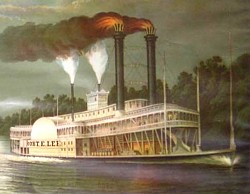
Caine is the name, and I served on the Danville train
’Til
Stoneman’s cavalry came and tore up the tracks again.
In
the winter of ’65, we were hungry, just barely alive.
By
May the tenth, Richmond had fell.
It's
a time I remember oh so well:
The
night they drove old Dixie down.
|
Back
with my wife in Tennessee
Now
I don't mind choppin’ wood, |
|
—“The
Night They Drove Old Dixie Down,” written by Robbie Robertson
In 1814 we took a little trip
Along with Colonel Jackson down the mighty Mississipp’.
We took a little bacon and we took a little beans
And we caught the bloody British in the town of New Orleans.We fired our guns and the British kept a-comin’.
There wasn't nigh as many as there was a while ago.
We fired once more, and they began to runnin’
On down the Mississippi to the Gulf of Mexico.—“The Battle of New Orleans,” written by Jimmy Driftwood
SEPTEMBER
29, 2026 PAIRADOTS
If you read news reports from the New York Times, you may have noticed that the publication's style guide has some unusual specifications. For example, on second mention the Times refers to the President as “Mr. Trump.” Almost every other newspaper omits the “Mr.”
One rule that I like concerns artificial intelligence. Most print sources abbreviate it to AI. Having learned to read many decades ago, I interpret the second character as a lower-case l, which leads me to think the abbreviation is Al as in Al Capone or Al Pacino or Al Gore. But the Times punctuates the abbreviation as A.I. for my benefit. The two extra dots slightly clutter up the page, but they're worth it.
Now we need to convince other media, such as television graphics, to follow this precedent.
SEPTEMBER
26,
2016 A
MAJOR INVESTMENT OF TIME
As I grow older, I’m gradually retiring, and this year I’ve worked my fewest baseball telecasts since 1982. However, this past weekend the Washington Nationals visited the Pittsburgh Pirates, and I was behind the graphics keyboard for more than enough pitches to make up for what I’ve missed. (While I was at it, I heard the MASN announcers invent the words exuberation and analyzation. They also quoted the classic lyric from Ozzy Osbourne, “I'm going off the rails on a gravy train.”)
|
Friday’s game lasted 11 innings and took 4:36 to play. Saturday’s game was relatively quick by today’s standards, requiring less than 3½ hours, but we stayed on the air an extra hour to interview the Nationals as they celebrated clinching the division championship. |
|

Then yesterday we endured “a very extended nine-inning ballgame,” in the words of Pirates manager Clint Hurdle. There was a benches-clearing fight, red uniforms scuffling with gold uniforms. There were many pitching changes — frequently double switches. The Nationals averaged one pitcher per inning (pulling their starter after 56 pitches), and they employed 15 other players. Combined, the two teams used 17 pitchers, one shy of the Major League record for a nine-inning game, and a total of 45 players, also one shy of the Major League record. And they were on the field for 4:01. Pittsburgh’s loss once again dropped their record below .500.
Fortunately I did not work the telecast of the previous meeting between these two teams, an 18-inning marathon in Washington on July 17. If you include that game and Saturday's spraying of the celebratory champagne, the last four meetings have averaged 12 innings and 4:43. Enough!
SEPTEMBER
24, 2026 BUZZING
THE ARCH
I feel I need to keep a constant watch on the news. Every few hours, there's a consequential new pronouncement from the Trump administration. Four days ago it was about his proposed 250-foot-tall Arch along the Potomac.
Trump posted on his social media platform that at the request of the U.S. military, he has “agreed to convert the magnificent Triumphal Arch ... into a top grade Military Complex/Triumphal Arch, to house, store, and have the rapid ability to use large numbers of drones, plus snipers on both the roof and plaza areas, and additionally have and hold large quantities of sniper ammunition in storage.”
A group of Vietnam War veterans have sued to stop the construction outside the entrance to the hallowed Arlington National Cemetery. Their attorney says Trump is “trying to paper over a patently unlawful project by giving it a veneer of national security justification.”
|
|
I'm somewhat familiar with the proposed location of the golden Arch, having once flown past it on my way to landing on runway 15 at the overburdened Reagan National Airport.
|
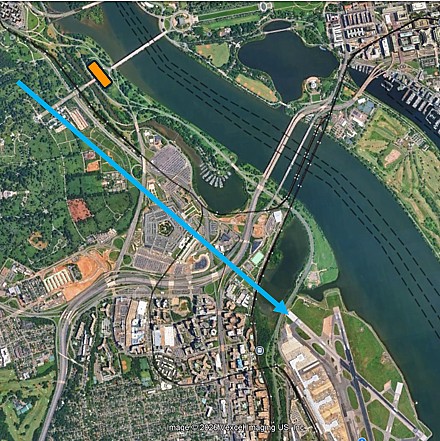
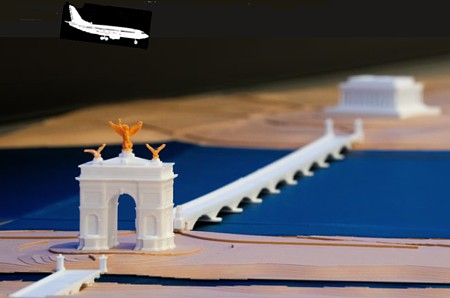
If I've figured this out correctly, the new Arch would be less than 200 feet to the left of my glide path to that runway and less than two miles short of the threshold. (Also on the approach path but six miles short of the runway is American University, another place where I've done TV graphics.)
Descending aircraft will pass the Military Complex at an altitude of only about 500 feet, well within range of its well-armed drones and snipers lurking on the observation deck. Would this be safe? The Federal Aviation Administration thinks so but warns that certain safety features would be required, such as a warning to pilots in the form of an “eternal flame” at the top of the structure.
The
New York Times commented, "The White House did not immediately
answer questions about the sudden need for a giant arch to host
drones in a region with a high concentration of military bases and
facilities. Mr. Trump has invoked national security concerns
for a host of reasons since returning to office. He has cited it as
the reason for deploying the military to the U.S.-Mexico border,
stripping union rights from thousands of federal workers, pausing the
construction of wind farms off the East Coast and exempting oil and
gas drilling in the Gulf of Mexico America from protections
for endangered species of whales.”
SEPTEMBER
22,
2016 MY
BROADWAY DEBUT
Thirty years ago I got an urgent phone call. “CBS has a big live awards telecast coming up this Sunday, from a theater on Broadway in New York City. But they've got a problem animating their graphics. And you're the only one who can save the day!”
|
|
Donning my imaginary superhero costume, that very afternoon I flew to Metropolis, where preparations were under way at the Minskoff Theatre on 45th Street for the 40th annual Tony Awards three days later. Quickly I solved the difficulty by demonstrating my somewhat obscure techniques to graphics operator Barry Fialk. I’d never met him before, but later he would book me for a couple of sports telecasts in New York. We had to leave the mobile unit temporarily so our conversation didn’t bother the producers and director sitting in front of us. Out on the street, Barry showed me the high-tech equipment (two separate trucks, for redundancy, because this was a prestigious prime-time special) that would transmit the live video all the way to the CBS Broadcast Center 15 blocks away. Then he took me backstage, and from the fly loft I looked down on Bea Arthur rehearsing her presentation far below.
|

|
Recently someone posted a tape of the Tony telecast to YouTube, so I can show you my work. It appears in the medley of recent show tunes beginning at 1:34:45. Very conventionally for 1986, the graphic font is merely Helvetica Bold with a four-line drop shadow. However, the words are surrounded by an oval of twinkling chaser lights designed by me! It wasn’t easy to achieve that animation on the rather primitive old Chyron IV. Details are in this letter that I wrote at the time. |
|

SEPTEMBER
20, 2026 A
THOUSAND WATTS ONCE MORE
My old college radio station is back on the air, as its fall broadcast season begins tomorrow. The Oberlin student newspaper reports: “WOBC Returns to FM Broadcast After Nine-Month Radio Silence.“
|
In my day, the door to WOBC-FM was at the opposite end of this recently-remodeled third-floor hallway. The photo is from the college's Around the Square newsletter, which notes, “Comprehensive renovations to Wilder Hall passed a major milestone this summer, as Phase 2 of the multiyear project concluded in time for the fall semester. “The heart of campus life for generations of Oberlin students, historic Wilder Hall offers a host of newly reimagined gathering spaces as well as spacious new offices and meeting rooms for Student Affairs staff and student organizations.“ |
|
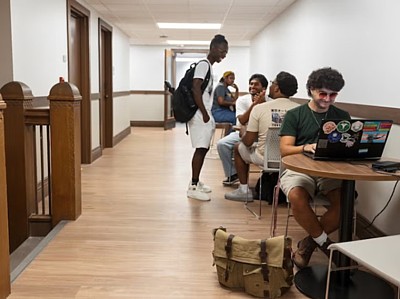
As Phase 2 draws to a close, the next seven projects include “completion of WOBC radio's fourth-floor studios and the Gear Co-op, as well as adjacent storage for WOBC. Phase 3 renovations will continue through the upcoming academic year, with completion scheduled for August 2027.“
|
|
SEPTEMBER
18, 2026 A couple of decades ago, I was sometimes hired to operate the graphics machine for telecasts of small-time sports on a local channel. There was football played by women's teams like the Pittsburgh Passion. And there was Arena Football played in what's normally a hockey rink. |
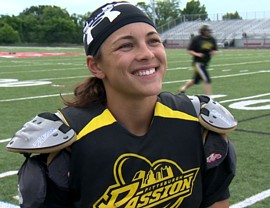
In big-time TV, lowly graphics operators like me don't talk to the producers. Any communication runs in the opposite direction and takes place through intermediaries. But interaction is more informal with small crews. Here's some examples I think I recall.
• On one show, our analyst was a former player. She had no broadcast experience and was rather nervous. The producer was recording a pregame segment during which she would describe the home team and then the visiting team — in that order, for no particular reason. I prepared the graphics to illustrate his points. But it turned out that the analyst preferred to give the points in the opposite order, which would flow better. I began rearranging the stack of graphics, but the producer didn't want to wait; he wanted to tell the analyst to reorder her comments. “No, no,” said I, madly clicking away at my keyboard. “Changing what she's already memorized would confuse her. I'll be done in a moment.” The director commented, “He's a pro.”
• In each quarter, TV was allowed to call time out at one change of possession for a commercial break. I noticed that the third quarter was almost over and we hadn't gotten our break yet and here was an opportunity. I pointed this out to the producer, who'd forgotten about commercials.. Good thing that someone was paying attention.
• Another game was almost over and the outcome was no longer in doubt. We had been on the air for slightly longer than our allotted time slot. After what appeared to be the final play, the producer began counting down to the end of the telecast. But I had an eye on my graphics. “There's three seconds left on the clock!” I cried, thus avoiding the faux pas of leaving the air while the game was still in progress. Good thing that someone was paying attention.
Small-time TV can be more fun.
SEPTEMBER
15,
2016 FIRE
UP THE ZAMBONI
They say that time passes more quickly as one gets older.
It was only three months ago that Pittsburgh held a huge parade to honor the Penguins for winning hockey’s Stanley Cup. But our brief summer hockey respite is already at an end. It’s time to start making ice again. The Consol Energy Center hosted a couple of World Cup of Hockey pre-tournament exhibitions last night, and the Penguins’ first preseason game is in Detroit a week from Tuesday.
Long ago when I was in high school, snapping whippers, our vacation time between athletic seasons was longer than three months. It was nine months. We never wearied of a sport.
|
|
Consider my classmate Criss Somerlot (1947-2023), a four-sport man. In August, Richwood High School began practice for high school football, where he was a lineman and placekicker. In November, we put away the pads and Criss became a forward on the basketball team. In February, we put away the basketballs and he started tossing the shot and discus. And in May, the track and field season ended and Criss headed to the baseball diamond. Criss went on to specialize in “the weights.” He set the Ohio University record in the hammer throw, a staple of the Olympics. (And of frustrated dads, according to Captain Obvious). Then Criss became a widely respected track and field coach. Next month he’ll be inducted into the OU Athletic Hall of Fame. |

Right now, many are growing tired of Major League Baseball — especially those of us who follow the Pittsburgh Pirates, losers of 13 of their last 16 games. The season started with spring training seven months ago and isn't scheduled to end until Game 7 of the World Series on November 2.
Bad news: I asked the groundhog whether autumn is just around the corner. He glanced at his shadow and said no, we’re going to have six more weeks of baseball.
SEPTEMBER
13, 2026
WHY
DO STUDENTS LEAN TOWARD SOCIALISM?
“Cheapatopia” is a utopian community proposed by Scott Adams in 2009, as I noted here. “Cheapatopia puts a big emphasis on social interaction. The only rides you would ever need would be to the nearest airport. There would be no cars within Cheapatopia. Most of your meals are eaten at the city-run all-you-can-eat buffets located in each neighborhood. Residents could get further discounts on their buffet meal plans by agreeing to work shifts at the cafeteria. You might find it fun to work with your neighbors for a few hours every week. Most people make their friends from their organized activities, past or present. They find their spouses and lovers the same way. Cheapatopia increases your social involvement and therefore your social life.
“Many of you believe Cheapatopia can't work because utopian communes have been tried and failed. And besides, you wouldn't want to live in such a socialist place. But Cheapatopia is designed with individual self-interest as the founding principle. Living in Cheapatopia is optional. Plain old capitalism will always surround it.
“The closest model is college dormitory living. In college, the meals are communal, the buildings are inexpensive, and the social life is organized and abundant.”
So that's why so many young college graduates embrace socialism!
“The usual assumption,” writes Kimberlee Josephson for the Wall Street Journal (quoted in The Week), “is that professors are indoctrinating students. But college life itself may be the main factor.”
|
Excerpts: “Lavish student centers, comfortable residence halls, well-equipped recreation facilities, dining halls with widely varied, all-you-can-eat meals. Students can enjoy these amenities without ever reaching for a wallet. None of it is actually free, of course — it's paid for by tuition or financial aid — but for most students the actual cost is invisible. |
|
“This illusion shapes students' economic expectations. No wonder they believe that government should provide public transportation, medical care, and child care for free.
“It's a blinkered way of thinking, but in college, young people are shielded from how the real world works.”
SEPTEMBER
11, 2026 GRADUALLY
DIVIDING?
In my local Tribune-Review, TribLive's Tom Fontaine notes that Gallup surveys occasionally ask whether Americans “are united and in agreement about the most important values.”
|
Of course, there was a patriotic spike following September 11, 2001. But Gallup's respondents fear that national agreement on values has sunk to less than half of what it had been 30 years earlier. I've plotted the data onto a graph. |
|


My Congressman, Chris Deluzio (D-PA), doesn't believe things are as bad as we might think. “Most people aren't sizing up whether a neighbor is a Democrat or Republican and then screaming at them if they're in a different party. People have hope for our country, and they want our country to succeed and do big things. I share that optimism.”
SEPTEMBER
10, 2026 UNTIE
MY WIFE!
|
Hi, folks! I'm Tucksey Doe, the penguin. You might recall that “Brother Billy” interviewed me once. (It's this month's 100 Moons article.)
|
The good brother tried to tell me that because we penguins can't read the Bible, we can't know how to behave morally. I replied that we don't need the Ten Commandments to understand that it's wrong to steal. Nor do we need the Holy Scriptures to teach us to help one another. Recently my wife became entangled in some string on the beach, and I had to search for the assistance of a human. I found one and tugged on his pants leg, and together we undid the string. My wife and I set off arm in arm for the safety of the sea, but I knew to stop and turn and bow my thanks to the human. If you haven't seen the video, here it is. |

SEPTEMBER
8, 2026 KIMCHI,
ANYBODY?

Not having followed sports controversies as carefully as once I did, I'm having trouble identifying unfamiliar terms.
What's the difference between “betting on Kawhi” and “betting on Kalshi”?
And then there are Kasha and Karhi and Korma and Kikiam and Kaniwa and Kjötsúpa, but I guess all those are foodstuffs.
When I was an Oberlin College student broadcasting games on the radio, I was more familiar with the names. It wasn't hard. My alma mater typically has fewer than 40 players on the football roster. Today, with only four wins since 2018, the Division III Yeomen might be the NCAA's worst football team.
|
|
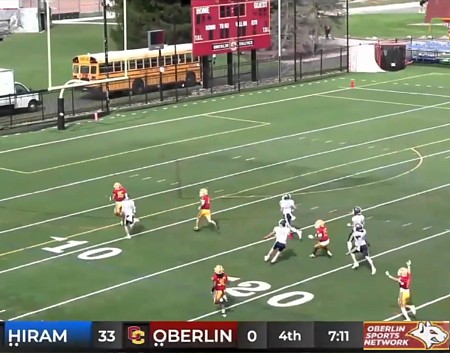
The Yeomen are not always held scoreless. A couple of points came in a 33-2 loss to Hiram at Oberlin on Saturday, when Kingston Askerneese ran back this blocked extra point. Nevertheless, notes Alex Valdes for The Athletic, in November 2025 ESPN's Bill Connolly had Oberlin ranked last among the nation's college football programs at #766. But their average GPA is 3.52, and coach John Pont is the grandson of the 1967 national coach of the year. |
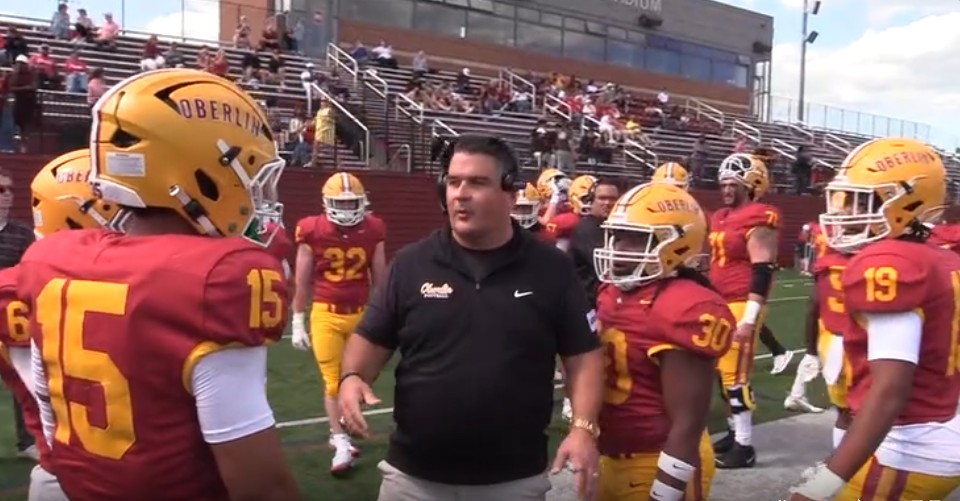
Natalie Winkelfoos, the athletic director since 2012, told Valdes that “it's a team that fights above their weight class. Oberlin is a high academic institution. The rigor is hard. Everything that they're doing is hard, but you would never know it because of the amount of joy that they're showing up with. Success belongs with the people that persist. That's Oberlin College football.”
On the other hand, Oberlin High School football will have no success this year. Only eight students showed up for the start of camp on August 3, and only seven the next day. The local school district noted, “Student participation has increased in other extracurricular activities, providing students with a wider variety of interests and opportunities. [But] despite extensive in-house recruiting efforts, participation has not reached a level necessary to safely sustain a varsity football program. The District has no choice other than to cancel the 2026 Oberlin High School football season.” Kimbap.
SEPTEMBER
5,
2016 FRIDAY
NIGHT LIGHTS
A century ago, the game of football was played by college and high school students on autumn Saturday afternoons. Then many high schools installed lights at their fields and began playing on Friday nights.

From
the 1954 Tigrtrax,
the Richwood High School Tigers kick an extra point.
The
lights at Memorial Field weren’t very bright,
so
the ball was white and the photographer used flash.
Meanwhile, professional teams claimed Sundays. They eventually competed most of the winter as well, into February. I grew up feeling this was the natural gridiron progression: high school on Friday night, college on Saturday, pro on Sunday.
That natural order began to break down with the debut of Monday Night Football in 1970, and a gradual relaxation of standards continues even today. This past Friday evening, there were five college games live on my cable TV — college games, not high school.
|
FS1 |
Kansas State |
vs |
8 |
Stanford |
||
|
BIG TEN |
Furman |
vs |
12 |
Michigan State |
||
|
ESPN |
Colorado State |
vs |
Colorado |
|||
|
ESPNU |
Toledo |
vs |
Arkansas State |
|||
|
CBSSN |
Army |
vs |
Temple |
Next Friday, two such telecasts are scheduled. High schools managed to preserve their Friday monopoly for a long time, but fewer kids are playing football these days and their time slot exclusivity seems to have gone away.
|
UPDATE, SEPTEMBER 5, 2026 Last night I watched two simultaneous Friday-night high school games on local TV channels. The somewhat more polished telecast was on WPKD-TV channel 19, which falsely claims its call letters are KDKA+ because it's co-owned by the CBS affiliate. Their cameras included a drone which gave us a beautiful overhead view of the Montour stadium with a fading sunset on the horizon. Later the drone turned to the east to show us the distant skyline of downtown Pittsburgh. On my second TV (with the sound off), I tuned in “Friday Night Rivals” on WPNT channel 22. The Mars at Aliquippa game had just started, and I watched Mars score a pick-six touchdown. I looked down at the score bug at the bottom of the screen. Uh-oh. It was trying to tell me that the game was still scoreless, and the situation was first and ten with 15:00 remaining in the 12-minute first quarter. This fake news remained for most of the period. Why did they keep lying to us? I knew there was another graphics machine available to identify people and Keys to the Game and such. They could have typed up a quick score using that machine. But the score bug included ads for a sponsor and the station, and those logos had to be aired. They could have aimed a camera at the stadium scoreboard — you know, that big red panel with all the amber bulbs standing right there on the far sideline. Finally we did get that shot with ten seconds to go in the period. And then as I watched, the score bug came to life. Aliquippa was threatening to score and its points scrolled upwards — no, wait, wrong team, take that down, Mars is the team that has six points. Then Aliquippa actually did score, so a 6 appeared for them. The extra point was good, so the score changed to 5. No, wait, we should have hit the up arrow; make that 7. Can we get someone in here who actually knows how to run this darn machine? Apparently they did so, because beginning with the second quarter all was well. The time remaining seemed correct, presumably because electronic data was coming from that big red scoreboard. Even the closed captioning magically began to work. As a retired former graphics operator for such telecasts, this drama fascinated me more than the actual game. The players seemed disorganized, knee pads were improperly worn, and in the second half (75° with 82% humidity) someone fell to the ground with cramps after almost every play. And I didn't like the light shows following touchdowns by the home team. Flicking the stadium lights off and on repeatedly may be safer and cheaper than fireworks, but I find it annoying. Hmph. |
SEPTEMBER
2, 2026 IT
TAKES A MULTITUDE
It's my understanding that an ordinary employee of a one-hour TV show can somehow obtain a title as one of the bosses. An actor, or even a gaffer or a dialogue coach, can be called an Executive Producer. That status is indicated by his on-screen credit and by the paycheck he receives.
At the end of Episode 4 of The Shards, I was astonished at the length of the credits. I had to rewind for a minute so I could count.
|
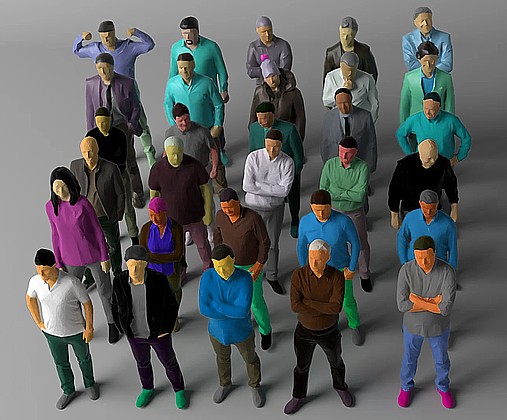
Then I searched for a stock picture depicting such an overgrown production staff — thirty highly-paid honchos in all! No shortage of jobs here. |
|
|
EARLIER
POSTS BY MONTH:
POSTS FROM 2007 THROUGH 2016:
|


